
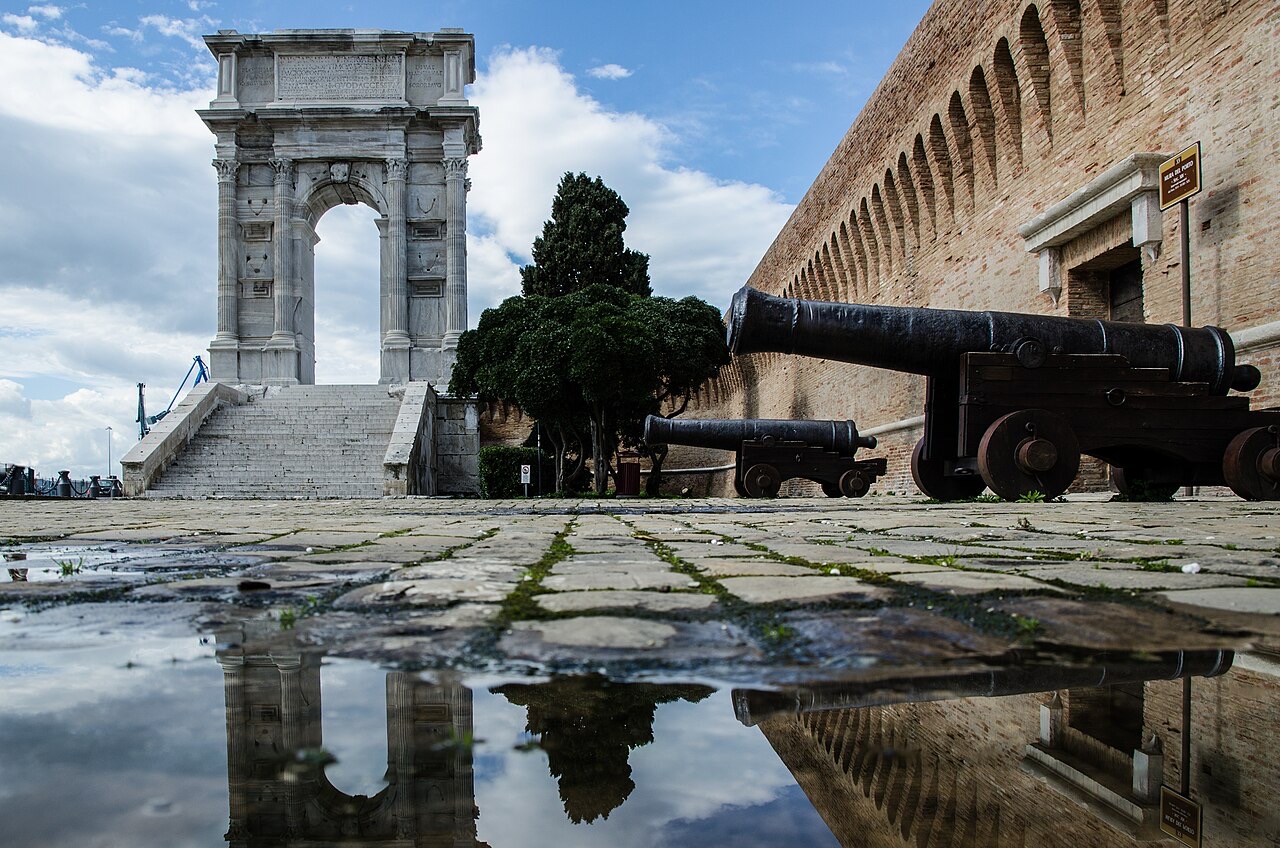
Most travelers drive straight past Ancona on their way to Greece or Croatia, because the ferries leave from its port. Those who stay find a city on a hill above the Adriatic Sea, with Roman remains, Greek origins and churches where Gothic and Renaissance meet. That makes a walk through Ancona surprisingly rich: in a single morning you pass through almost three thousand years of history, and everything lies close together.
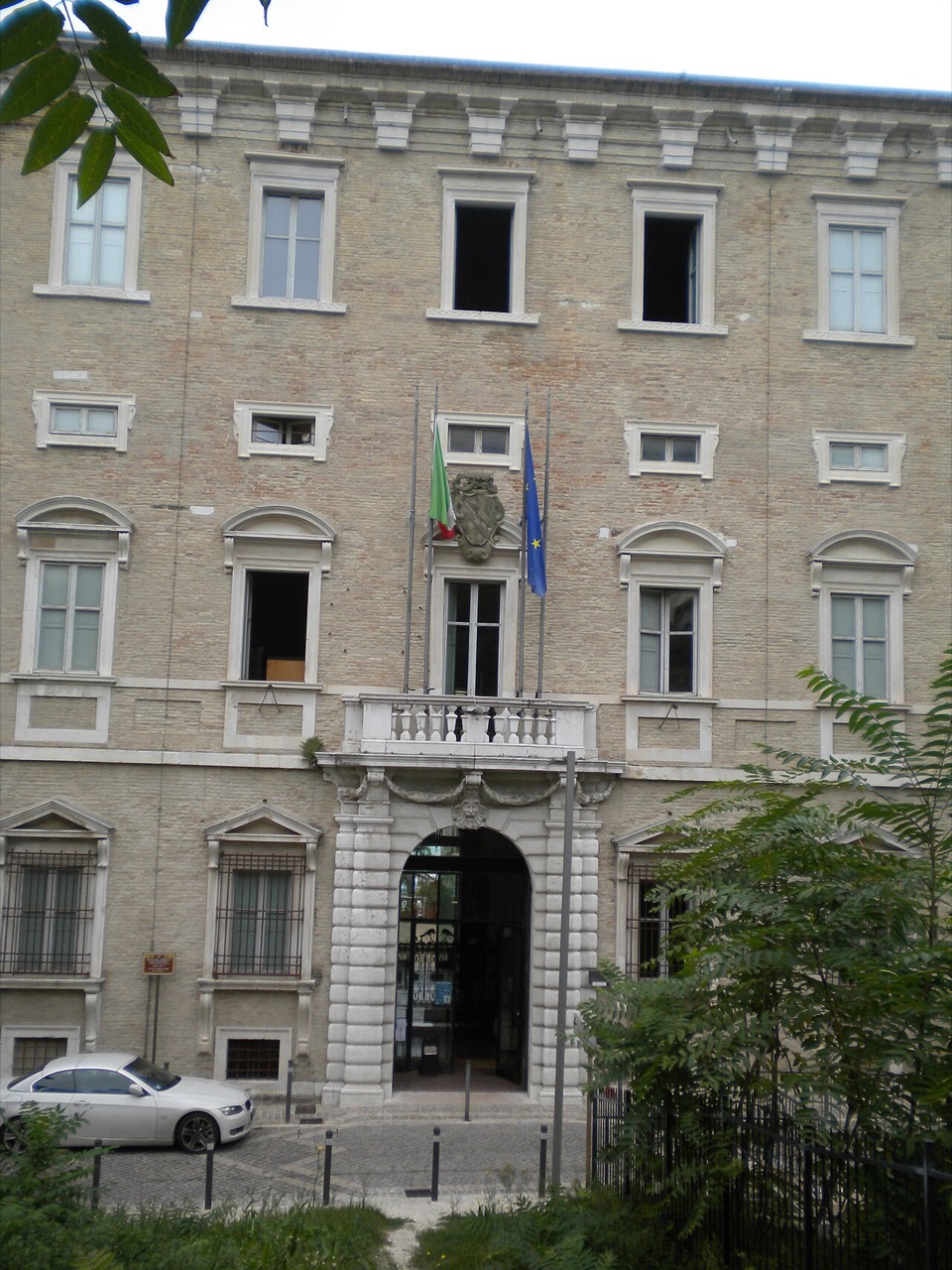
From cathedral to amphitheater: the old town above the harbor
You begin down at the harbour, at the Arco di Traiano. The Roman Senate and people built this marble arch around the year 100 in honour of Emperor Trajan. From there you climb about 55 metres up Colle Guasco to the old town. At the top stands the Duomo di San Ciriaco, the cathedral dedicated to Saint Cyriacus. From its square you look out over the port and the gulf.
Nearby lies the Roman amphitheater, the Anfiteatro romano. Roman spectators streamed in here through the porta pompae, the main entrance, whose remains you can still see in the south. After the Arch of Trajan, the amphitheater is Ancona's most important Roman monument. Since 2025 it has belonged to the Italian network of national museums, and excavations have started again. So the story is not finished yet.
Just a little further on stands the Chiesa di San Francesco alle Scale. The name says it all: "alle Scale" means "by the steps", and the church has always kept that address. It is dedicated to Francis of Assisi, the wealthy merchant's son who chose a life as a poor friar.
Squares, a fountain and an architect from Dalmatia
Piazza del Plebiscito is simply known to locals as the "piazza del Papa". The name comes from the statue of Clement XII, the eighteenth-century pope who breathed new life into the port. The square was laid out in the fifteenth century and is the oldest of the four main squares: the piazza grande where the three old districts of the city came together. If you soon hear water splashing, you have reached the Fontana del Calamo, a Renaissance fountain that Ancona also knows by a second name.
The Fontana del Calamo is older than it looks. A fountain already stood here in Greek times. Pellegrino Tibaldi designed the present one in 1559 and 1560. Thirteen spouts pour out water side by side, hence its other name: the fountain of the thirteen spouts. Twelve of its masks are bronze and the middle one is stone.
The name of Giorgio da Sebenico turns up several times in Ancona. In the fifteenth century he united Gothic and Renaissance in the sculpture of the Chiesa di Sant'Agostino, typical of the Adriatic Renaissance. The church itself dates back to the fourteenth century and was later completely renovated by Luigi Vanvitelli. The same Dalmatian architect designed the facade of the Loggia dei Mercanti. Four statues show the virtues of a good merchant. Above them rides the knight from the city's coat of arms. After a fire, Pellegrino Tibaldi decorated the great hall inside with frescoes. Allied bombs damaged the building in the Second World War.
Gates, quays and the soil of Ancona
The Mole Vanvitelliana lives up to its name: "mole" in Italian means a colossal structure, and the addition reveals that here too Vanvitelli was the designer. Walk along the outside and let its sheer size sink in.
Porta Pia has a good story too. Pope Pius VI promoted its construction, and the name "Pia" honors him. In barely two years, from 1787 to 1789, the gate rose as a monumental entrance to the city.
Anyone who walks through a small gateway in the old city wall toward the quays passes Santa Maria della Piazza. This church from the eleventh and twelfth centuries stands on a fourth-century basilica. Through two glass panels in the floor you look down at early Christian mosaics and ancient Greek walls. They were discovered during a restoration that was completed in 1928.
The Museo archeologico nazionale delle Marche rounds off that story. The Picene collection, from the ninth to the fourth century BC, is the most complete in existence. The museum also tells the story of Greek Ankón, the Senone Gauls and Rome. Nothing comes from aristocratic collections: everything was dug out of this soil over more than 150 years.
More than this overview
This article is just a taste of what Ancona has to offer. The full walk has more stops, questions and hidden details. If you really want to walk the route, choose the Ancona walk in the CityWalkGems app and let the city tell you the rest itself.
- 12 stops
- Start anywhere
- ~4,6 km route length
- ~800 m longest stretch
- about 1,5–2,5 h duration
- Free

