
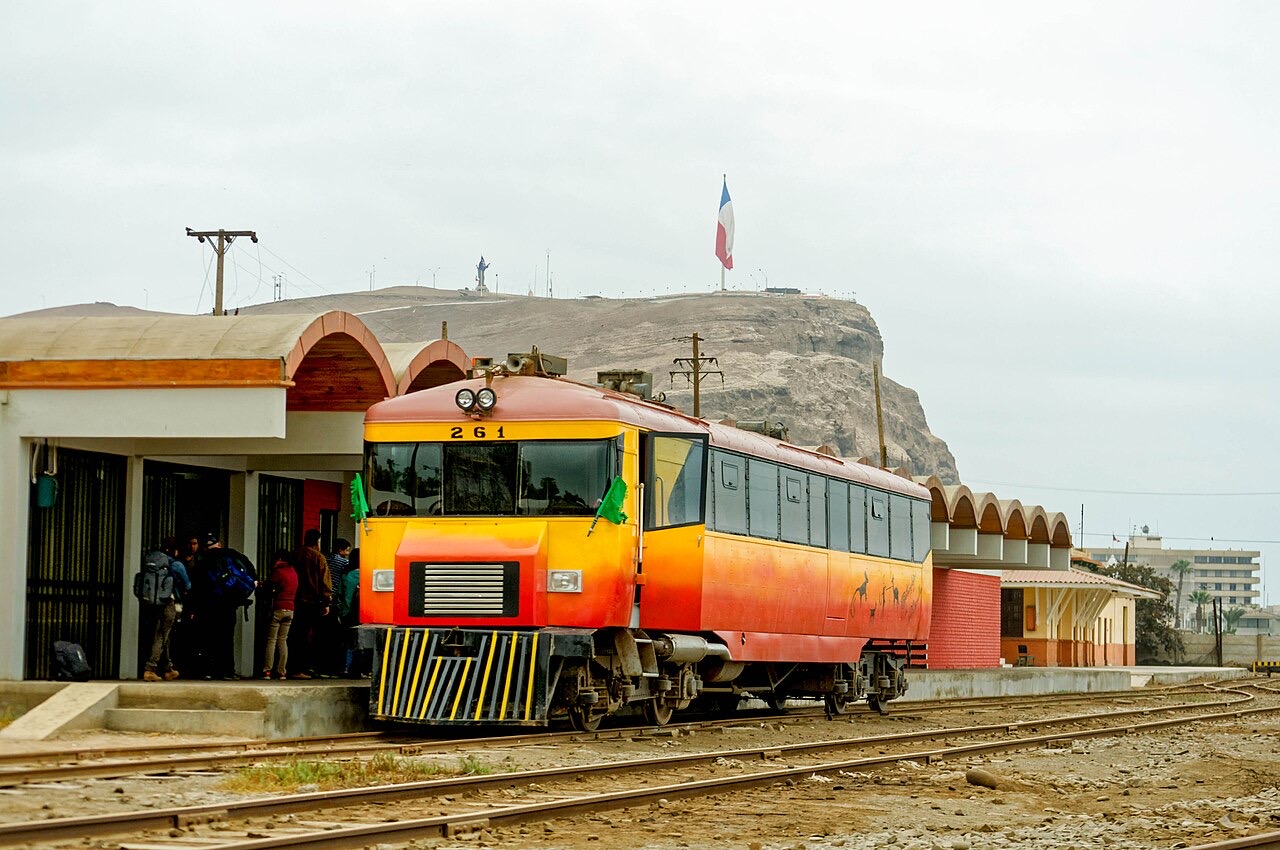
Arica lies at the very north of Chile, on the border with Peru, at the edge of one of the driest deserts in the world. Anyone who takes a walking tour of Arica will pass, within a few hours, railways, a French ironworks designer, a port that also serves Bolivia, and a hill where a battle of 1880 and two-thousand-year-old mummies come together. That Arica belonged to Peru for centuries and only became Chilean after the War of the Pacific can still be seen along the route.
Iron, bricks and rails
Start at the Estación Arica–Tacna. The line that begins here is one of the oldest on the American continent: in 1856 the first train covered the roughly 60 kilometers to Tacna. An English company built and operated it for decades. With the Treaty of Lima of 1929, the entire line, including the stretch on Chilean soil, passed to Peru; today the Tacna region manages it. The station building dates from 1986 and only a few trains run per week, so check the timetable if you want to ride.
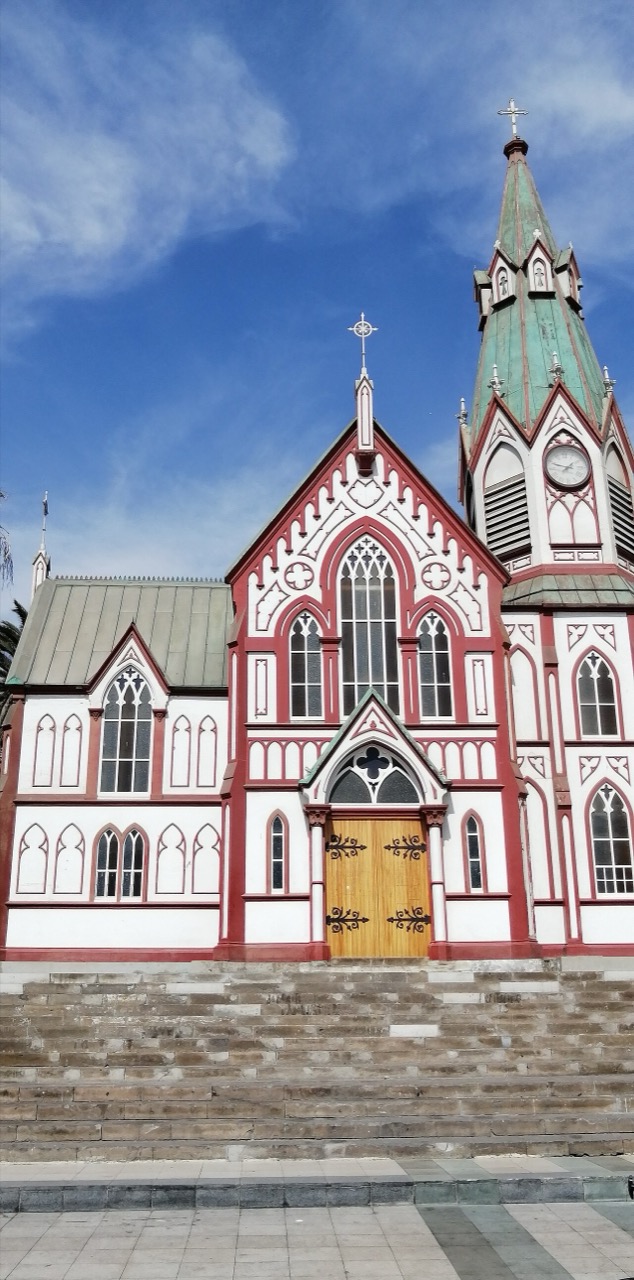
Closer to the center stand two buildings that share the same origin. In 1868 an earthquake destroyed Arica's old parish church. A committee of women from the town asked President José Balta for a prefabricated church from abroad, and he agreed. The parts of the Catedral de San Marcos arrived in 1875, and in 1876 the church opened on the ruins of the old one. The design has long been attributed to the workshops of Gustave Eiffel, although historians still debate its precise origin. Since 1986 it has been a cathedral and national monument.
A little further on stands the Ex Aduana, the old customs house, which also replaced a building lost in 1868. In 1871 the Peruvian government ordered a new prefabricated complex, designed according to most sources by Eiffel's firm in Paris. The outer walls are made of bricks from France, the roof and interior pillars of metal. After the War of the Pacific it remained a customs office under Chile until 1977. Since 1991 it has been the Casa de la Cultura, restored in 2020.
On the way, the Paseo 21 de Mayo takes you through one of the busiest shopping streets in the center. The name refers to 21 May 1879, the naval battle of Iquique, which is still a national holiday in Chile.
A seaport for two countries
The Ex Estación Arica–La Paz opened on 13 May 1913 as the coastal terminus of the railway to Bolivia, built by Chile after a 1904 treaty with Bolivia. The line is 440 kilometers long, 233 of them in Bolivia, crosses the Andes at 4,265 meters and is the shortest rail route from the Pacific Ocean to the Bolivian highlands. The British firm Sir John Jackson completed the line and also supplied this building. Regular passenger trains to La Paz ran until 1996.
That connection explains the nearby Puerto de Arica. This is a working port, not a postcard: you hear steel containers and engines. A large part of the overseas trade of landlocked Bolivia passes over these quays, making Arica a seaport for two countries at once.
The Morro: war, mummies and a monument to peace
At the end of Calle Colón the footpath begins that climbs up the Morro, which rises steeply some 139 meters out of the Pacific Ocean. Just before it stands the Casa Bolognesi, which under the Treaty of Lima of 1929 belongs to Peru, in the middle of a Chilean city. On 5 June 1880, two days before the Battle of Arica, Colonel Francisco Bolognesi, commander of the Peruvian garrison, received a Chilean envoy here who asked him to surrender. He refused: he had sacred duties and would fulfill them "to the last cartridge". Those words are still remembered in Peru.
The hill itself is older than the war. Long before a city stood here, the Chinchorro lived on the northern slope; they mummified their dead some two thousand years before the Egyptians. In 2004 construction workers at Calle Colón 10 found some of their mummies, which now lie where they were found. On 7 June 1880 the Morro was the scene of the Battle of Arica, which both Chile and Peru still commemorate. At the top you will find a museum and a viewpoint.
There, too, stands the Cristo de la Concordia, a 15-ton statue of Christ that began as a bronze figure of just 30 centimeters by designer Raúl Valdivieso. The parts arrived from Spain in 1987 but were kept in storage for years. On 7 March 2000 the foreign ministers of Chile and Peru unveiled it together, because the Treaty of Lima provided for a peace monument on the Morro. Hence the name: concord. Bring water and a hat, because the desert sun is fierce up here.
Even more to discover
This is only a taste of what the route has to offer. Along the way, quiet squares are waiting, a park that is green only thanks to every drop of water, and details you only notice when you look closely. The complete walk through Arica contains more stops and quiz questions than I could fit here. Choose it in the CityWalkGems app and discover for yourself what is still hidden between the station and the Morro.
- 11 stops
- Estación Arica–Tacna start
- ~3,8 km route length
- ~737 m longest stretch
- about 1,5–2 h duration
- Free

