
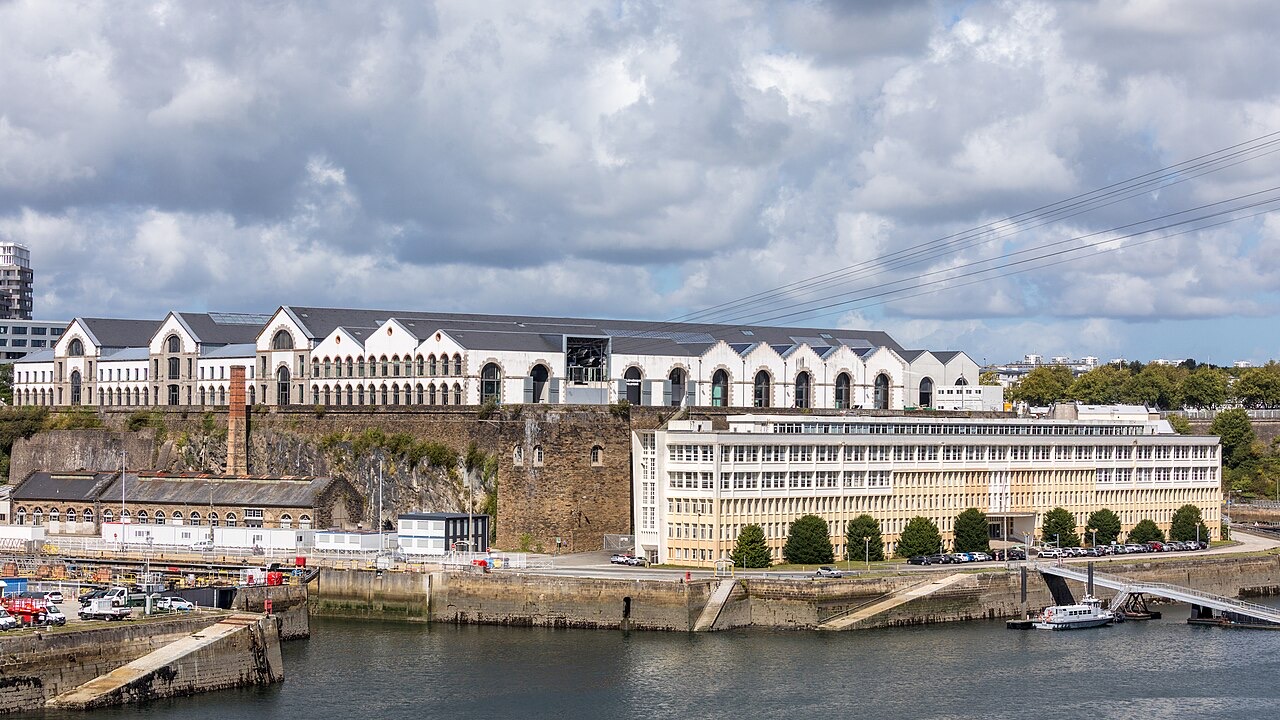
Brest isn't a city you visit for a pastel-coloured centre full of half-timbered houses. It is a naval city at the mouth of the Penfeld, where halls, bridges and fortress walls tell the story of what the harbour meant through the centuries, and where the post-war reconstruction remains visible everywhere. If you are looking for things to see in Brest, you will find them mostly along the water and around the arsenal, within walking distance of one another. Below is a selection of what you will come across along the way.
The Arsenal and the Penfeld
The best place to start is the Ateliers des Capucins. These enormous halls were built for the navy in the 19th century, passed to the city in 2009 and are now a cultural and commercial centre. Inside, you stand beneath roofs that make you feel small without trying. Overhead you sometimes hear a soft hum: that is the cable car, which has a stop here.
That cable car, the Téléphérique de Brest, links Siam with the Capucins across the Penfeld. Each of the two cabins holds sixty people, for a capacity of 1,200 passengers per hour. When it opened on 19 November 2016, it was the first cable car of its type in France since the Bastille one in Grenoble. In Brest it is simply bus line C. Technical problems have stopped it several times, so if it's running, hop on.
Just below the plateau lies the Rue Saint-Malo, a street in Recouvrance that began in the late 17th century. The lowest houses survived the wartime bombing, and from 1965 the city wanted to demolish them. Since 1990 the association Vivre la Rue has kept them alive with art and culture. In 2015 nearly twenty thousand people visited. The Madeleine steps lead you back up to the Capucins.
Nearby stands the former Pontaniou prison. In 1810 the building became the arsenal's prison, designed with conditions for inmates that were exemplary for the time. After the Second World War it became a civilian prison; it slowly became unfit for use and closed for good in 1990. You can see it from the outside, and that is enough.
In Recouvrance stands the Église Saint-Sauveur, the oldest church in Brest. It was built between 1740 and 1749 to plans by Frézier, in a plain Jesuit style, and the war largely spared it. Its predecessor, the church of lost time, was demolished in 1724 because dockworkers had built it badly.
Play Brest right in your browser →
Towers, a Bridge and a Castle at the River Mouth
The Tour Tanguy rises from a rocky hill on the edge of the Penfeld, reached via the square Pierre-Péron at the foot of the pont de Recouvrance. The tower was built in the 14th century as the Quilbignon bastion and now houses the museum of old Brest.
Beside it stretches the pont de Recouvrance, built in 1950–1954 to replace the earlier Pont National, which Allied bombs and then dynamite put an end to. Each concrete pylon is seventy metres high. The bridge was inaugurated on 17 July 1954 and was for a long time the largest of its kind in Europe; the movable section dating from 2011 is 88 metres long. Walk to the middle: below you lies the arsenal, behind you Recouvrance, ahead of you the rue de Siam.
At the foot of the bridge stands the Arbre empathique, a metal tree by the Barcelona sculptor Enric Ruiz Geli. In 2009 the city set aside one million euros for artworks along tram line A, and this tree is one of the seven.
Across the Penfeld lies the Château de Brest, the oldest monument in the city. It stretches from a Roman castellum to Vauban's citadel, with more than 1,700 years of history. It is considered the oldest castle in the world still in use and has been protected since 1923.
A City That Started Over After the War
Brest was hit hard in the war, and you can see it in the buildings. The Église Saint-Louis replaced the old church, built between 1686 and 1785, which lay in ruins. The reconstruction produced the largest church rebuilt after the war in France, designed by Michel, Lacaille, Lechat, Perrin-Houdon and Weisbein. Since 2018 the church has been a listed monument.
Le Comœdia was built in 1949, just after the war, as a classic Italian-style theatre designed by Michel Ouchacoff. In 1962 it became a cinema and in 1991 it closed. Since 2019 it has been an art gallery.
On the cours Dajot stands the Tour rose, as the people of Brest call the Monument naval. The memorial was erected in the 1930s, destroyed during the German occupation and rebuilt identically in 1958. Since July 2015 it has been a listed monument. Also note the name of the street itself: in Brest's spoken language you often hear “cours d'Ajot”.
More Than This Selection
This is only a selection of what you will come across along the way. The full walk through Brest contains more stops, quiz questions and hidden details that we are deliberately keeping from you here. If you want to walk the city yourself, from the arsenal to the river mouth, choose the Brest walk in the CityWalkGems app and discover the rest as you go.
- 12 stops
- Ateliers des Capucins start
- ~4,3 km route length
- ~742 m longest stretch
- about 1,5–2,5 h duration
- Free

