
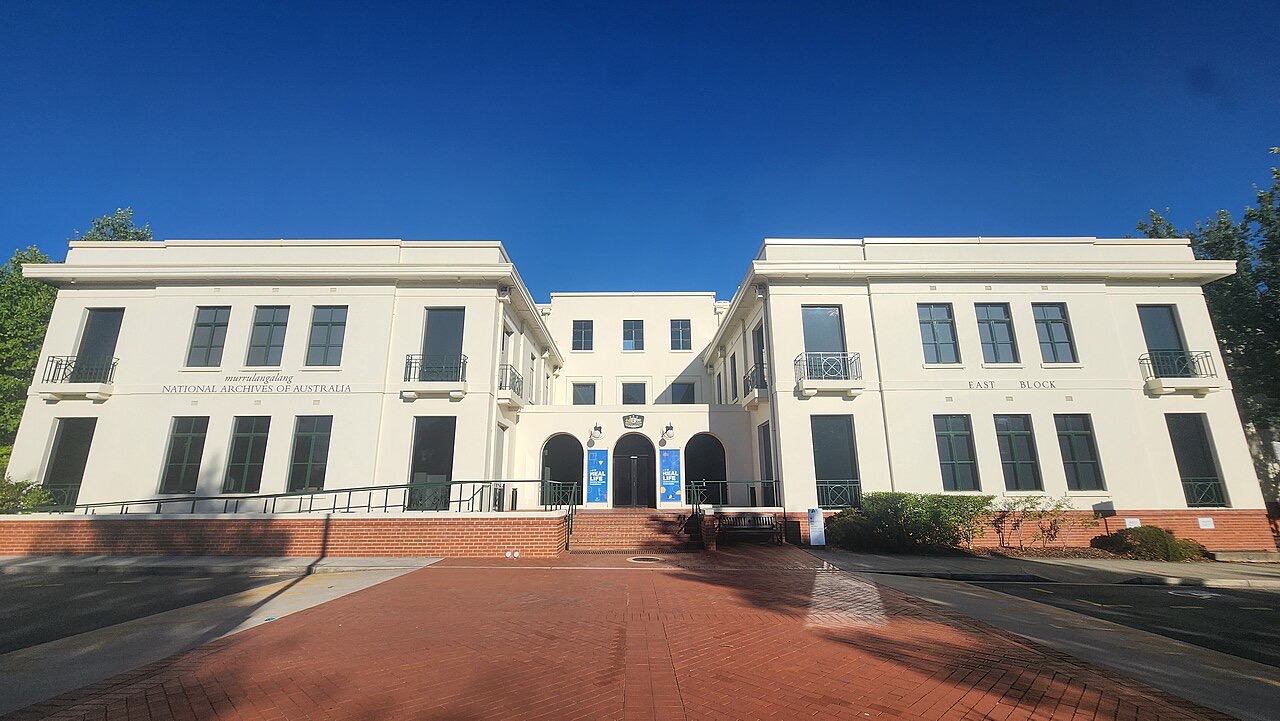
Canberra is not a city that grew over centuries, but a capital that was conceived on paper. That makes it different from most places you travel to: the sights are within walking distance of one another, around the water and the parliamentary zone, and almost every building or monument has to do with government, memory or law. Anyone who takes a walking tour of Canberra is therefore strolling through a country in miniature, which explains why a relaxed walk here yields so many stories.
A Country That Keeps Its Own Papers
You start at the National Archives of Australia, which is a fitting opener. Since the Archives Act of 1983, this institution has decided which government records the country keeps and has made them open to the public. Through exhibitions, books and education programs, those files become stories.
A little further on stands the National Library of Australia, where the numbers are just as staggering. The manuscripts alone fill 17,950 metres of shelving. In June 2019, the country's largest reference library held 7,717,579 items, gathered under a 1960 act that requires it to collect everything about Australia and its people: newspapers, manuscripts, images and born-digital material.
The National Gallery of Australia also fits this pattern of collecting. The national art museum, formerly the Australian National Gallery, holds more than 166,000 works of art, one of the largest collections in the country. In 2022 it was led by director Nick Mitzevich.
Democracy in Bronze, Grass and Brick
The strongest part of the route revolves around the question of how a country governs itself. At Old Parliament House you grasp this immediately. The building was officially 'provisional': it was meant to serve Parliament for 50 years at most, yet it did so from 1927 to 1988. The team of John Smith Murdoch designed it in a restrained 'Stripped Classical' style, orderly and symmetrical, but without columns or pediments. Today it houses the Museum of Australian Democracy.
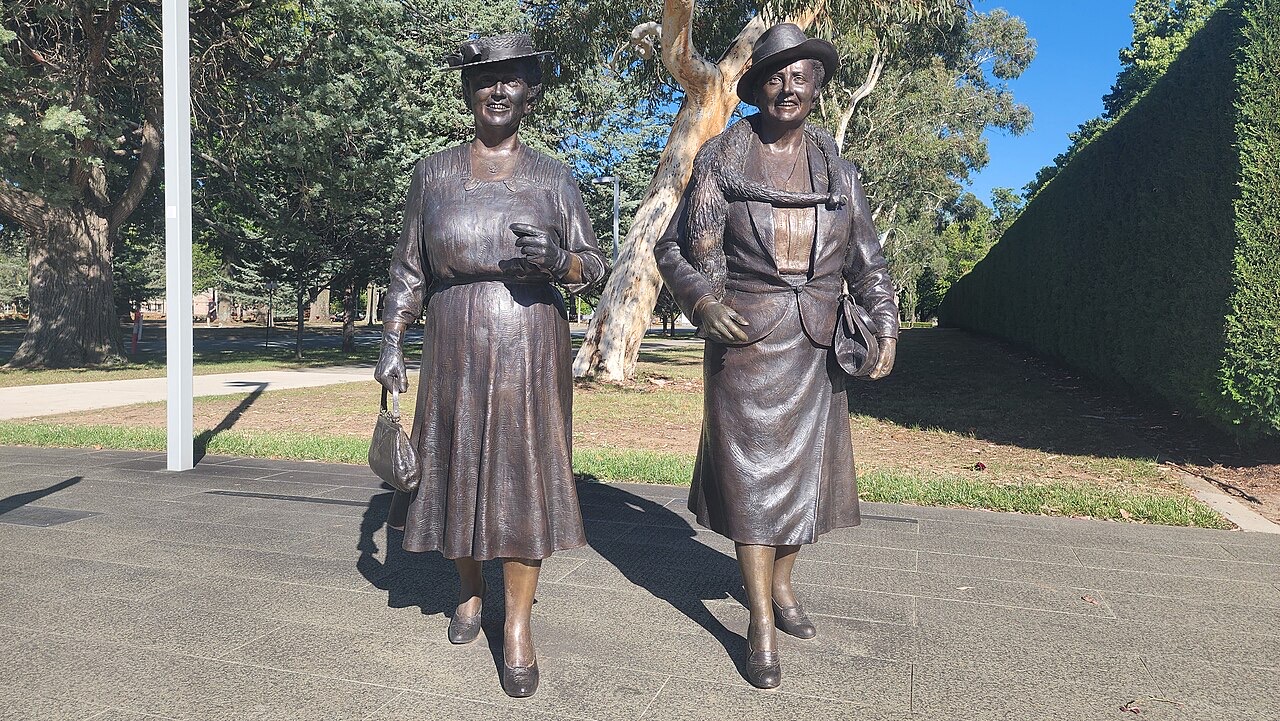
Along the way you come across the bronze statues of Dorothy Tangney and Enid Lyons. Tangney was the first female senator, Lyons the first woman in the House of Representatives. In September 1943 they walked into Parliament House together on their very first day, and a camera captured it. Sculptor Lis Johnson used that photograph as her model. They are the first statues of women in the parliamentary zone.
Opposite Old Parliament House stands a very different kind of monument: the Aboriginal Tent Embassy. Signs, tents and a strip of grass, nothing more, and that is precisely the message. The embassy began on Australia Day, 26 January 1972, as a protest against the McMahon government's land rights policy, and has stood on this spot since 1992. Nowhere in the world has a protest for Indigenous land rights lasted longer.
Reconciliation Place follows on from there. This landscape in the Parliamentary Triangle is dedicated to reconciliation between Australia's Indigenous peoples and the predominantly European settler population, and opened in 2002. It works best when you walk through it slowly.
By the Water: Roses, Flags and the Highest Judges
Canberra has gentler corners too. The National Rose Gardens became Australia's first national garden project: every state sent roses. Conceived in 1926 and opened in 1933, the formal layout was meant to show how the Commonwealth and the states work together. Since 2004 the gardens have been on the Commonwealth Heritage List.
At Commonwealth Place, a row of flags lines the shore, one for every country with a diplomatic mission in Canberra, plus the United Nations, the European Union and the Holy See. Walter Burley Griffin, the city's designer, envisioned a 'water gate' here with a terrace above it, a 'forum for the people'. The paved artwork in Speakers Square was a gift from Canada for the centenary of Federation.
Magna Carta Place is linked to the same centenary: Britain gave its monument for the centenary of Federation. The site was dedicated in 1997, seven hundred years after Edward I sealed Magna Carta. A genuine 1297 copy, bought by Australia in 1952, is kept in nearby Parliament House.
The walk ends at the High Court of Australia, above which no court stands. Seven justices, led by a Chief Justice, hear the cases granted 'special leave', and they have done so in Canberra since 1980.
This Is Only a Taste
This article doesn't cover every stop on the route, and certainly not every detail. More stops lie in wait along the way, an interactive science attraction, quiz questions and small things you only notice when you deliberately look for them. If you want to discover Canberra that way, choose the city walk in the 'CityWalkGems' app and let the route do the work.
- 12 stops
- National Archives of Australia start
- ~3,6 km route length
- ~658 m longest stretch
- about 1,5–2 h duration
- Free

