
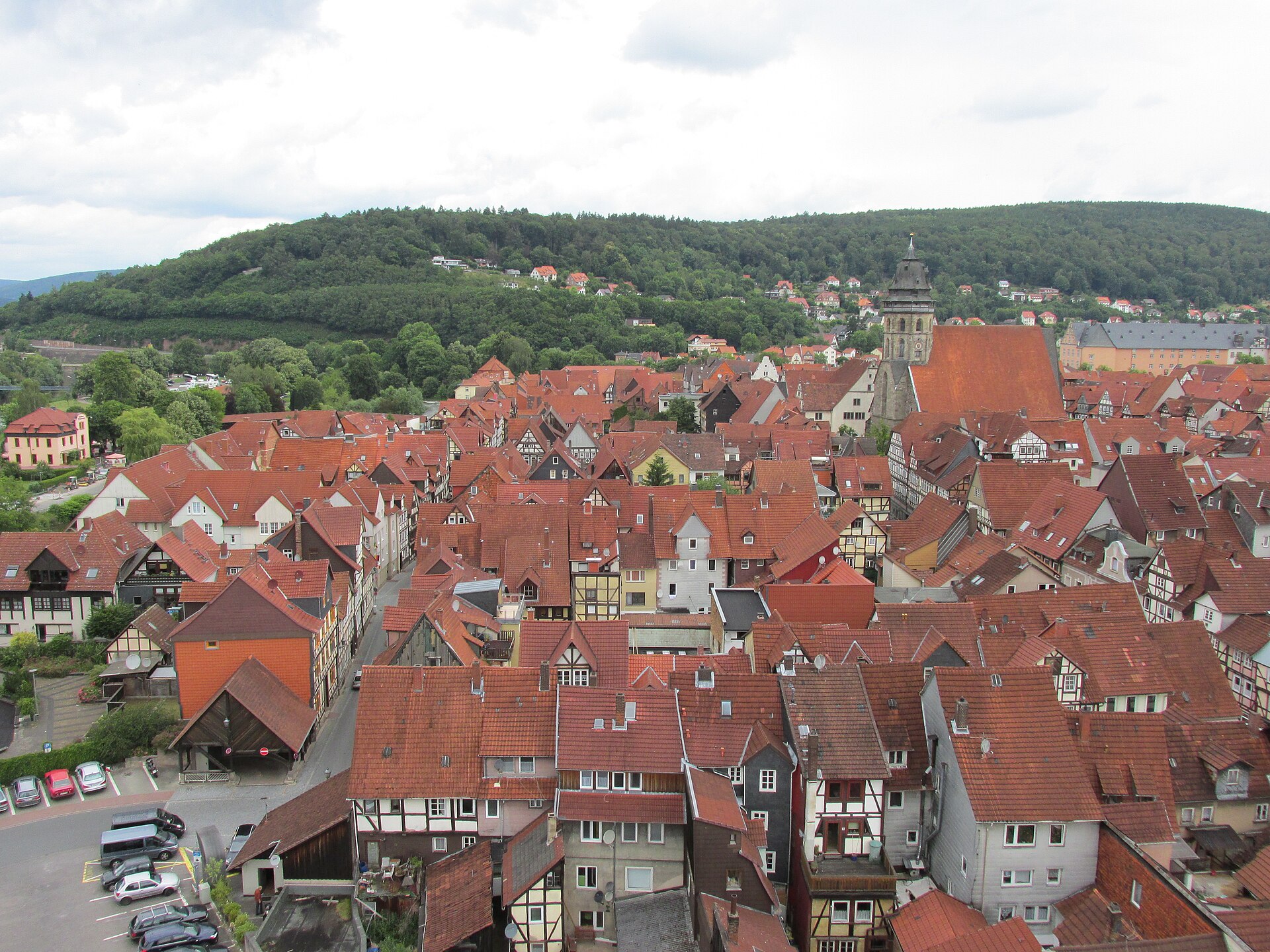
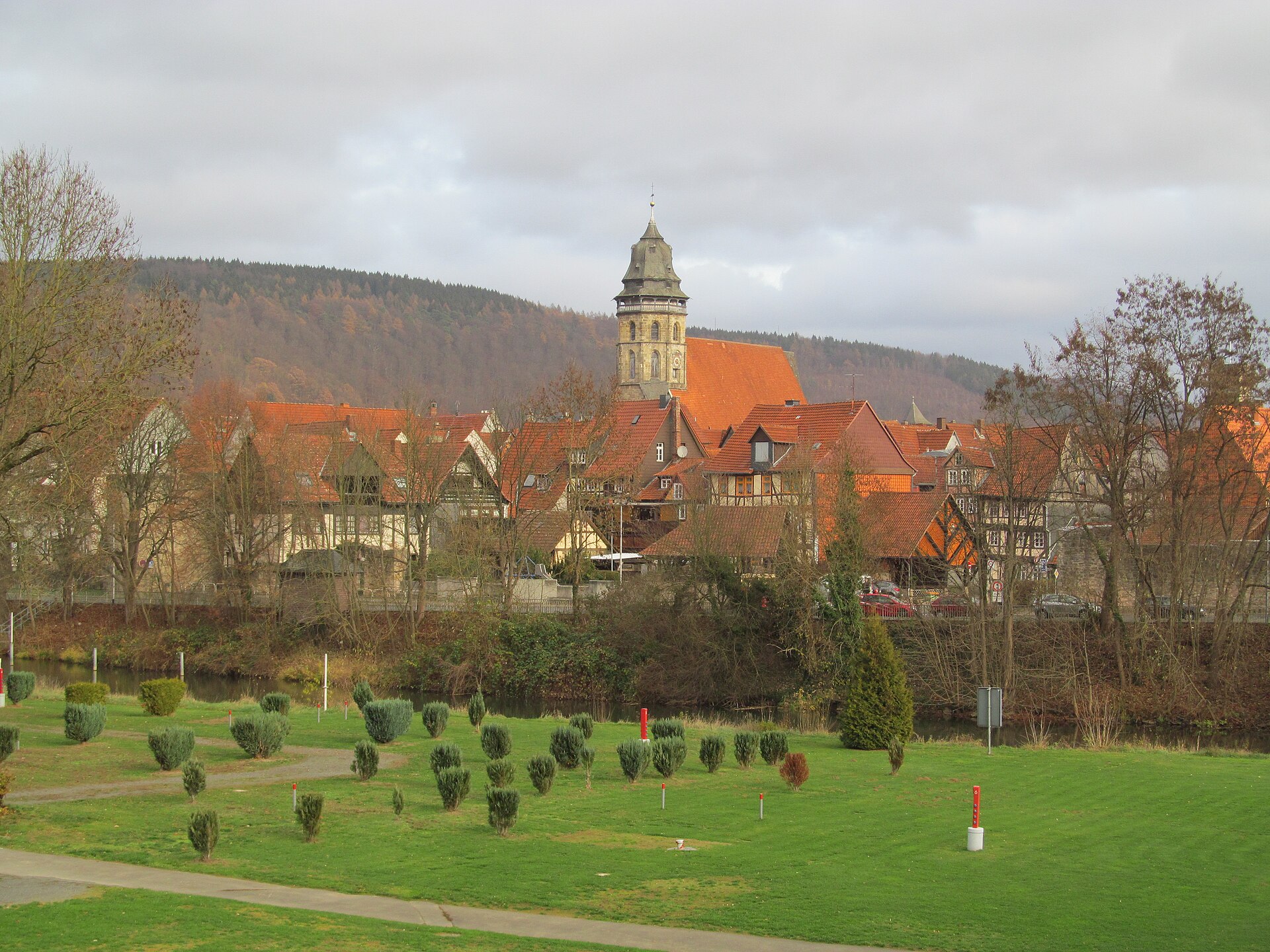
In the south of Lower Saxony lies a town whose entire identity is shaped by flowing water and ancient trade routes. In a deep valley, two rivers meet to form a new one: the Werra and the Fulda merge here to become the Weser. Over the centuries, this strategic location brought Hann. Münden great wealth, but it also made the town a coveted target for besiegers. Anyone taking a walking tour of Hann. Münden quickly discovers that the past is not locked away behind museum glass here, but is tangibly present in a streetscape of timber, stone, and water.
Two Streams Become One: Waterways and Early Industry
The natural heart of the town lies at the very tip of Tanzwerder Island. Here, you can hear the water lapping against the embankments on both sides until the two currents meet. At this exact spot, the Weserstein marks the starting point of the Weser—the great river that flows from here all the way to the North Sea. A poem chiseled into this glacial erratic reminds generations of walkers of the moment the Werra and Fulda surrender their names to the new waterway.
The rivers served not only for transport, but also accommodated remarkable industrial structures. Close to the banks of the Fulda stands the Hagelturm (shot tower), a striking relic of bygone times. Liquid lead was once poured from the top through sieves into the depths below. During free fall, the metal cooled and solidified into perfectly spherical lead shot before being collected at the bottom.
A little further upstream, the Alte Werrabrücke has spanned the water for centuries. Built around the year 1300, this stone arch bridge is considered one of the oldest preserved bridges in all of Germany. With its massive stone piers, the structure has withstood more than seven hundred years of ice floes and raging floods, while trade caravans between Thuringia and Lower Saxony moved their goods across this vital river crossing.
Play Hann. Münden right in your browser →
Rich Woodcarving and the Footsteps of Doctor Eisenbart
As soon as you leave the riverbanks and enter the historic town center, the scenery changes completely. Hann. Münden boasts one of the densest and richest ensembles of half-timbered architecture in Central Germany, featuring over seven hundred meticulously restored houses. The facades display colorful wood carvings, ornamental gables, and overhanging upper stories that testify to the wealth river trade brought to the town's burghers.
On the market square, the Town Hall forms the central focal point. Its richly decorated Weser Renaissance facade attracts onlookers daily for a unique carillon and figurine play that commemorates a remarkable historical figure: Johann Andreas Eisenbart. This itinerant physician and surgeon died here in 1727. Although a later satirical song portrayed him as a mere quack, he was in fact an exceptionally skilled doctor of his era. His legacy lives on not only on the market square: on the nearby island of Doktorwerder in the Werra, he once cultivated his medicinal herbs. Today, this leafy island serves as a peaceful sculpture park where modern works of art stand harmoniously among ancient trees and gently rippling water.
Fortress Walls, Rulers, and Panoramas
It was not only merchants and healers who left their mark; the region's rulers also shaped the town's destiny. Following a devastating town fire in 1560, Duke Erich II had the Welfenschloss (Guelph Castle) rebuilt. The castle seamlessly combines defensive fortification walls with princely Renaissance facades, concealing rare sixteenth-century frescoes within.
To truly grasp how strategic yet vulnerable Hann. Münden once was, one must look up at the surrounding wooded hills. Perched high on a forest vantage point stands the Tillyschanze. From this location during the Thirty Years' War in 1626, the imperial commander Count Tilly positioned his cannons to bombard the fortified town in the valley into submission. The present observation tower was erected in the nineteenth century as a lasting monument to that siege.
Those wishing to round off their visit with a panorama of the entire landscape can head to the Weserliedanlage on the Questenberg. From this scenic terrace, where the famous "Weserlied" was written in 1835 in praise of the river, your gaze sweeps across the sea of red-tiled roofs, historic church spires, and the converging rivers that have embraced Hann. Münden for centuries.
This selection reveals only a fraction of the layered history woven through the cobbled streets and along the riverbanks. On the interactive walking tour in the CityWalkGems app, you will discover even more historical details, curious riddles, and hidden corners of this half-timbered gem. Download the route and let yourself be guided step by step through the secrets of Hann. Münden.
- 11 stops
- Tillyschanze Tower start
- ~4,7 km route length
- ~783 m longest stretch
- about 1,5–2,5 h duration
- Free

