
Kassel is not a city you walk through on autopilot. It is the city of documenta, where art does not stay indoors but ends up on squares, in churches and even underground. At the same time, there is a layer of history here that was scarred by the war, and some places have deliberately not been smoothed over. If you are looking for a city walk in Kassel that offers more than facades, this is a route where art, fortified towers and remembrance flow seamlessly into one another. You walk along the Fulda, through the city centre and finish on a square that hides more than you can see.
Art on the Street
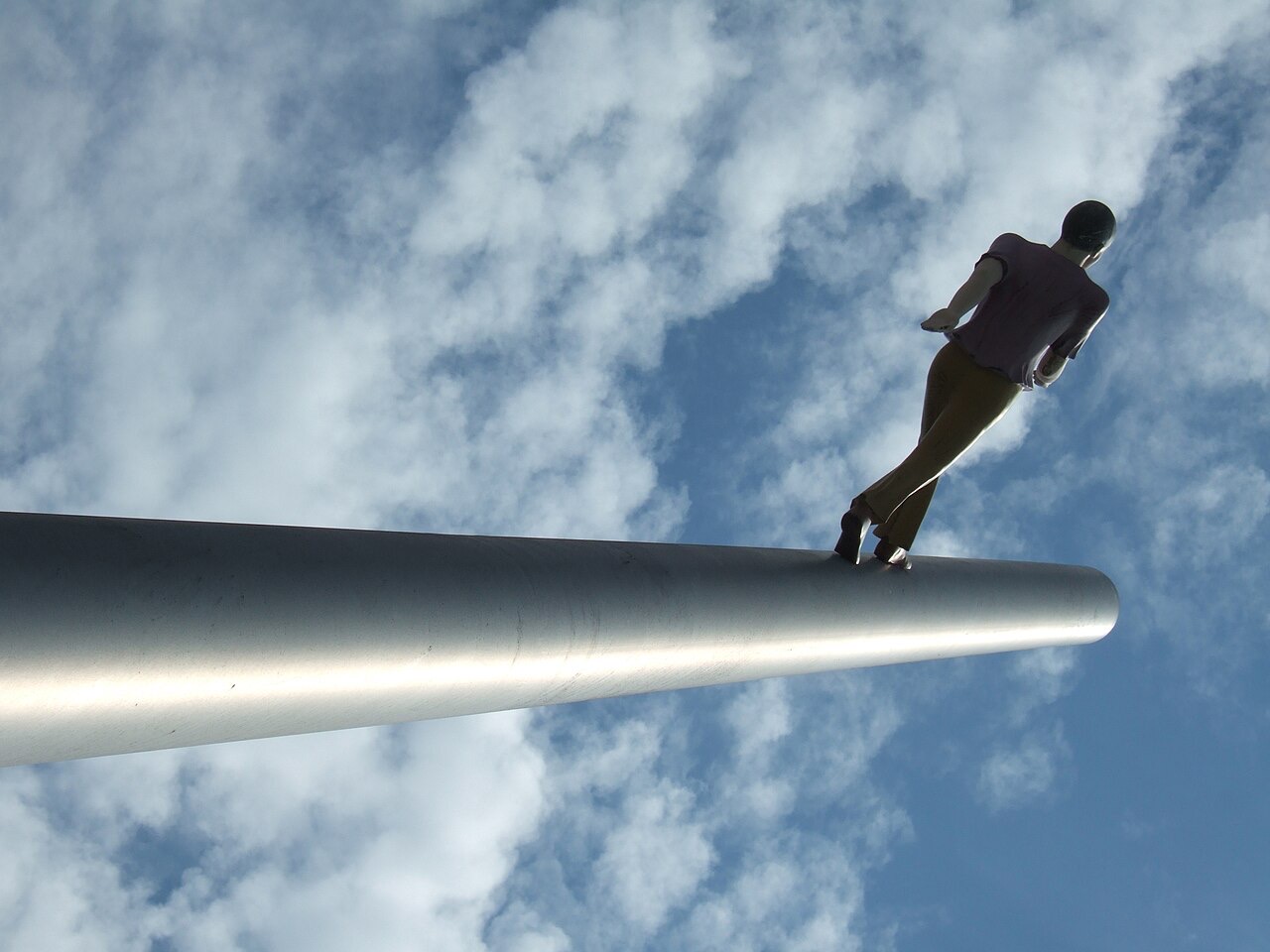
The route begins at the Himmelsstürmer, a name you have to say out loud: literally a sky-stormer, and in everyday German also a fiery dreamer who aims higher than seems wise. It is a fitting start for a city that lets itself be challenged by art.
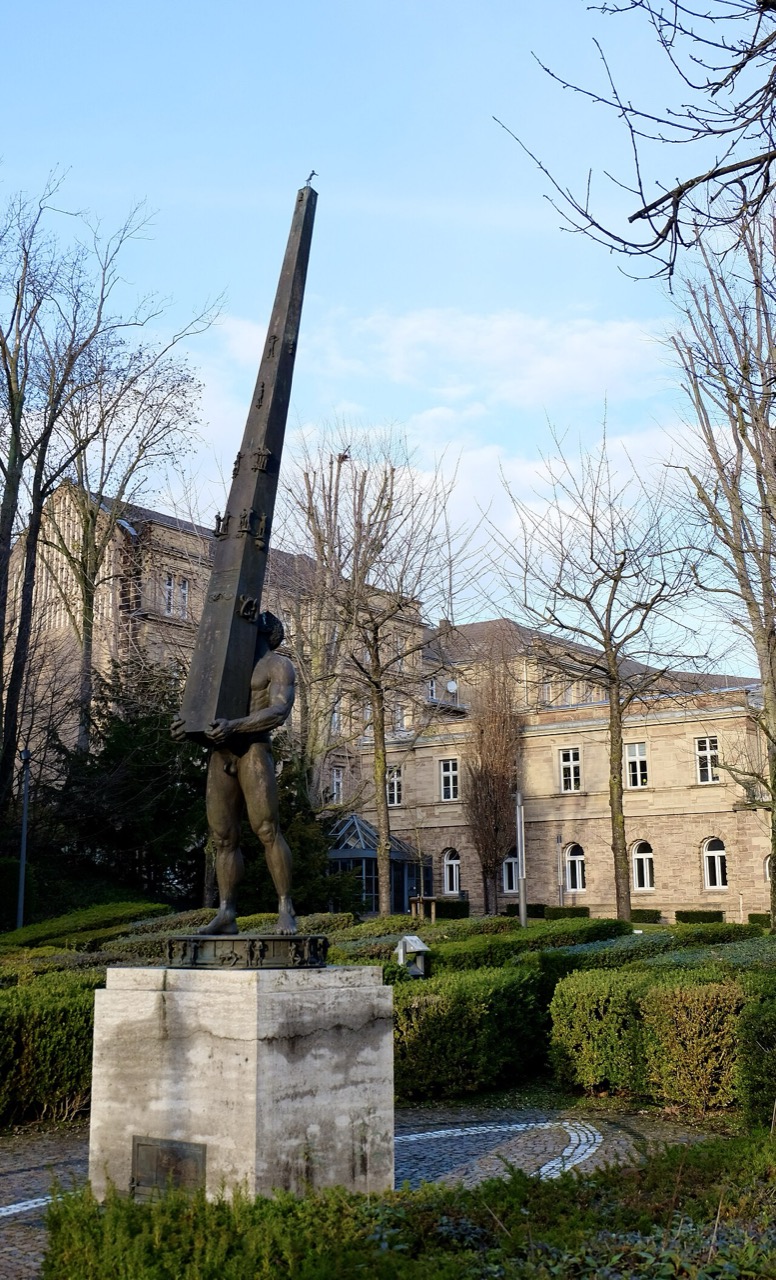
A little further on stands another sculpture that makes you doubt your eyes. A naked Hercules lugs an obelisk ahead of him, as if he were moving house with a monument. The bronze is by the sculptor Ivan Theimer and was installed on 18 April 1989 in front of what was then the local branch of the Landeszentralbank on Ständeplatz. Ancient myth, parked in front of a bank.
Gentler in tone is the Entenliesel on the Entenanger: a girl with a duck, around 150 centimetres of sandstone, in place since 1959. She was made by the Kassel sculptor Karl-Max Steffens. The basin of the fountain is a remnant of the Fischbrunnen from 1883, and together with the square she is protected as cultural heritage.
The Karlskirche, also known as the Oberneustädter Kirche, was built by Paul du Ry and consecrated in 1710. Its ground plan is an elongated octagon, and since Easter 1957 a carillon has rung from it.
A Fountain That Makes Loss Its Subject
The most haunting sight is the Aschrottbrunnen. In 1908 the Jewish industrialist Sigmund Aschrott donated a monumental fountain to the city. On 9 April 1939, National Socialist activists destroyed it. After the war the basin became a flower bed with a fountain. In 1987 the artist Horst Hoheisel, commissioned by the city, gave the work a new form: a memorial that makes the loss itself its subject. It is not a place for a quick photo, but for pausing in silence.
The Martinskirche, too, carries this layering. This Gothic hall church with a twin-towered west façade was begun before 1364, consecrated in 1462 and partly rebuilt in altered form after the Second World War. The bishop of the Evangelical Church of Kurhessen-Waldeck preaches here. From 1960 until his death in 1993, the renowned organist Klaus Martin Ziegler was cantor here.
Towers, Walls and a River
Kassel has lost almost its entire city wall, but you can still follow it. On Hedwigstraße, look at the paving: stones of a different colour trace the course of the old wall. It was demolished between 1767 and 1774. The Druselturm, 44 metres high and round, remained standing. Together with the Zwehrenturm, it is the last tower of Kassel's fortifications.
On the Steinweg stands the Ottoneum, built from 1603 to 1606 under Landgrave Moritz and named after his son Otto. Since 1884 it has been Kassel's natural history museum, home to the skeleton of the Goethe elephant.
The Drahtbrücke provides some breathing space, a pedestrian bridge over the Fulda in the middle of the city centre since 1870. Stop halfway and look in both directions along the river. At the edge of the Karlsaue park stands the Orangerie, built between 1703 and 1711 under Landgrave Karl as a winter home for delicate citrus trees. Today the building collects something quite different from fruit.
Your walk ends at the Fridericianum on the Friedrichsplatz. Simon Louis du Ry built it from 1769 to 1779, and it counts as the first building designed as a museum from the start. Every five years it is the heart of the documenta.
More Than a Taster
This article covers only part of what the route has to offer. The full walk through Kassel contains more stops, a number of questions and details you only notice if you look closely. If you want to discover them yourself, choose the Kassel walk in the CityWalkGems app and explore the city at your own pace.
- 12 stops
- Start anywhere
- ~4,4 km route length
- ~712 m longest stretch
- about 1,5–2,5 h duration
- Free

