
Traveling through the Moravia region, Kroměříž reveals a striking contrast between unpretentious provincial life and regal majesty. Along the eastern approach roads, such as Hulínská, everyday life revolves around horticulture and landscaping; trucks rumble over the tarmac while the earthy scent of potting soil lingers in the air. Near the railway station on Nádražní, depots filled with historic locomotives and carriages belonging to the Kroměřížská dráha railway society serve as reminders of nineteenth-century industrial acceleration, when passengers and sugar beets were hauled along the Haná lines. Yet, stepping into the town center transports you to a completely different world. A walking tour of Kroměříž guides you through centuries of ecclesiastical power, mathematical garden design, and pivotal milestones in Central European history.
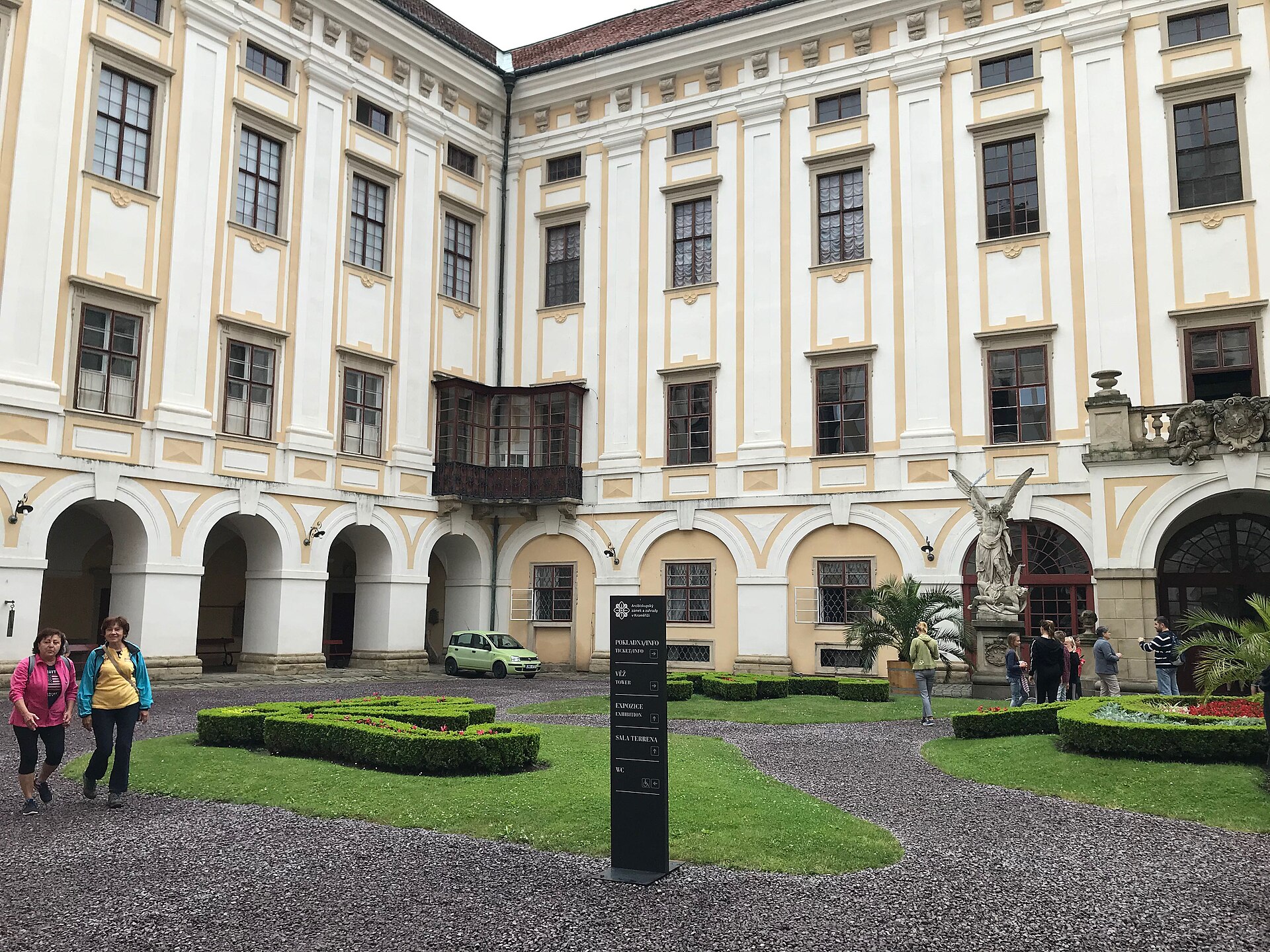
The Seat of Power of the Prince-Bishops
The town's core is dominated by the Archbishop’s Palace, its monumental façade commanding Sněmovní náměstí. From this very seat, the prince-bishops of Olomouc governed both their temporal and spiritual domains for centuries. The residence was far more than a regional power hub; in 1848, it became a stage for continental history when the Austrian Constituent Imperial Diet fled the Vienna revolution to deliberate a new constitution within these gilded halls.
Immediately behind the palace lies the Castle Garden, an expansive park sprawling across dozens of hectares down to the Morava River. What began as a utilitarian orchard transformed over the centuries into a vast, romantic landscape park, where peacocks roam manicured lawns and centuries-old oaks and beeches reflect upon still waters. Tucked away in the greenery stands the neoclassical Chrámek přátelství (Temple of Friendship)—an intimate domed pavilion where bishops and their guests sought contemplative retreat, reflecting Enlightenment ideals that harmonized classical antiquity with nature. A short stroll further reveals the Pompeian Colonnade: an evocative nineteenth-century peristyle built to conjure the atmosphere of a submerged Mediterranean villa, providing walkers with sheltered respite from passing rain and intense summer sun.
To pass from the palace grounds to the town’s fortifications and historic water mills, travelers once passed through the Mlýnská brána (Mill Gate). The echo of footsteps across the cobblestones beneath its vaulted stone archway recalls its defensive role of bygone eras; it remains the only surviving gate of the fortifications that once encircled the town.
Musical Resistance and Mirrors Around the Square
On the other side of the gate, the historic center opens up around Velké náměstí. Tucked behind the dignified facades of this central town square lies a playful contrast to the solemnity of the administrative quarters: the Zrcadlové bludiště mirror maze. Inside, dozens of mirrors bend reality into comical silhouettes and disorienting dead ends, offering a lighthearted diversion amidst your exploration of the monumental streets.
Just one street over, on Prusinovského, the walk adopts a more somber, contemplative tone at the permanent exhibition dedicated to Karel Kryl. In austere, atmospheric rooms, visitors are greeted by the resonant voice recordings and sharp acoustic guitar chords of the legendary bard who grew up in Kroměříž. Kryl's poetic protest songs became the musical anthem of resistance following the 1968 Soviet-led invasion. For years, his exiled voice was broadcast illicitly into living rooms across Czechoslovakia via clandestine radio frequencies.
Continuing across Masarykovo náměstí, where pastel-hued townhouses and relaxed café terraces connect the chateau quarter to the southern neighborhoods, broad tree-lined avenues lead you onward to the town's most celebrated green sanctuary.
Early Baroque and Geometry in Květná zahrada
On the western edge of the town center lies Květná zahrada (the Flower Garden), a seventeenth-century pleasure garden commissioned by Prince-Bishop Karl von Liechtenstein-Kastelkorn. The complex stands as one of Europe's most pristinely preserved early Baroque formal gardens. Here, amidst meticulously sculpted boxwood parterres, towering hedge labyrinths, and an elongated gallery of classical statues, you enter a sensory realm radically distinct from the English landscape park at the palace.
The absolute focal point of this geometric universe is the central Rotunda. Step inside to discover cool tranquility beneath a lavishly frescoed dome, where a monumental Foucault pendulum traces its steady path across the stone floor. Looking outward from the central hall, every vista in the garden fans out toward the horizon with flawless mathematical precision. It provides a magnificent culmination to a walk that highlights the rich, multi-layered soul of this Moravian gem.
This selection of highlights offers just a glimpse of the rich heritage and captivating stories Kroměříž has to offer. Along the full walking route, you will encounter numerous additional stops, local curiosities, and historical secrets that bring the town vividly to life. To explore all of its hidden corners at your own rhythm, you can launch the complete self-guided route directly on the CityWalkGems app.
- 12 stops
- Květinářství Zázrak start
- ~4,9 km route length
- ~917 m longest stretch
- about 2–2,5 h duration
- Free

