
Nouméa is a city where France, Kanak culture and the South Pacific meet within a few square kilometres. It began in 1854 as Port-de-France, grew as a penal colony and became the American headquarters in the South Pacific during the Second World War. You can still see it as you walk. If you are wondering what to do in Nouméa besides the beach, the centre offers a compact route where all those layers lie on top of one another. Here I have picked a selection of the places that stayed with me most.
Start at the Water and with the Kanak
Start early in the morning at the Marché de Port Moselle. Nouméa has had a market since the days of Port-de-France, around 1860, but the current pavilions opened on 20 April 1991, on land reclaimed from the sea. They stand next to Port Moselle, the largest marina in New Caledonia. Every yacht that reaches the country via Nouméa must first moor here for customs. Inside you will find tropical fruit, vegetables, flowers, local handicrafts and a separate fish hall. The market is closed on Mondays, and by late morning most stalls are packing up.
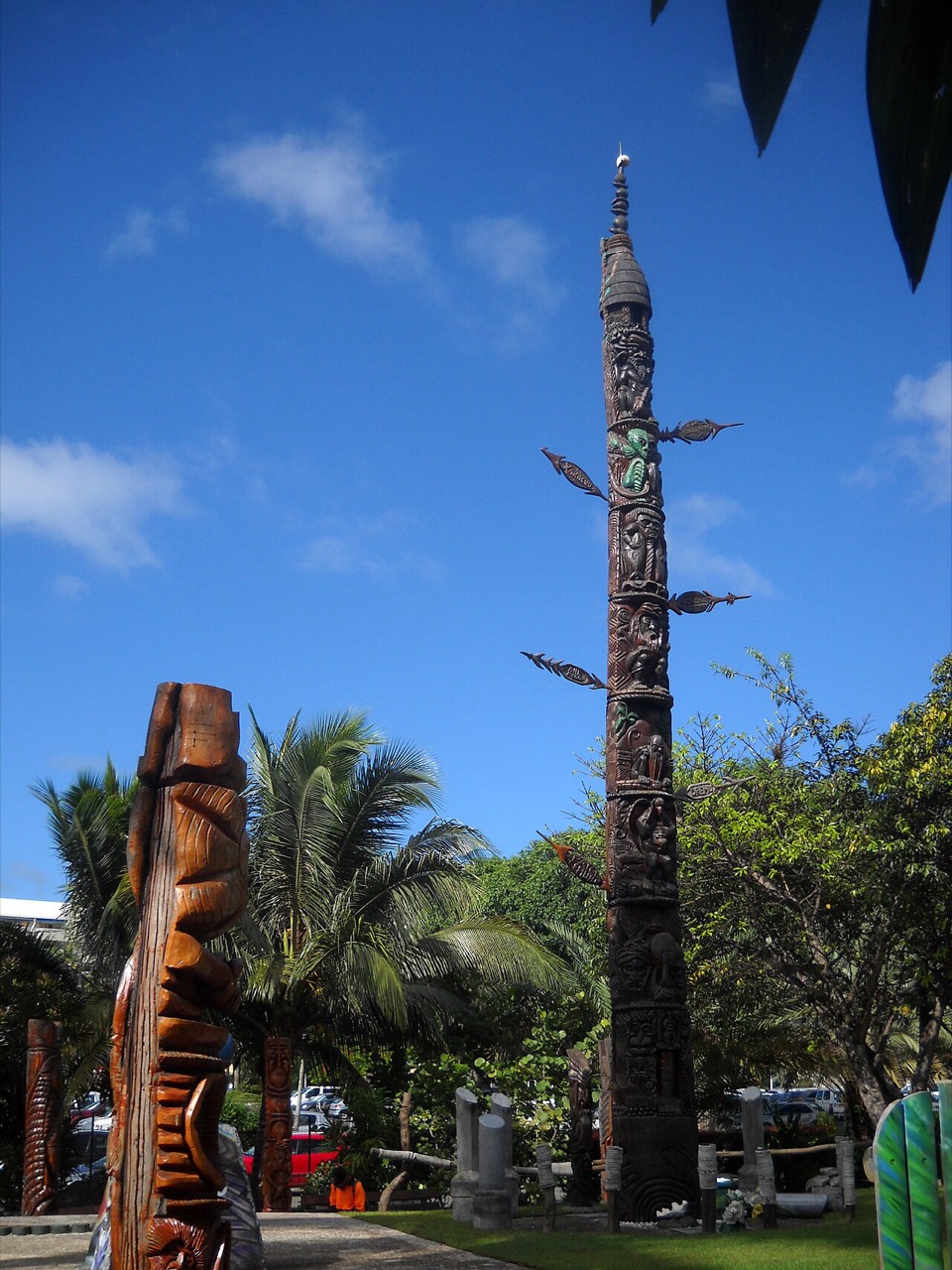
A few hundred metres further on stands the Mwâ Kâ, a 12-metre totem. The name is usually translated as “house of the people”: a place to gather and talk. The totem has eight carved sections, one for each of the eight customary areas of the Kanak country, and each section was made by an artist from that area. At the top stands a flèche faîtière, the carved roof spire that crowns a chief’s great hut. The Kanak community chose to raise it around 24 September, in the mid-2000s. On that date in 1853 France took possession of New Caledonia, for many Kanak long a day of mourning. In this way the date gained a new, shared meaning. Across the road, the Musée de Nouvelle-Calédonie has displayed Kanak and Pacific cultures since 1971. It has been undergoing expansion and renewal as MUZ since 2019, so check whether it has reopened.
Colony, Church and Buildings with a Story
The penal colony physically built Nouméa. The Cathédrale Saint-Joseph stands high above the street and was built between 1887 and 1897 by convict labourers, based on plans by a former convict named Labulle. The church is 56 metres long and its two towers are 25 metres high. Spires were planned, but they vanished from the drawing board because of the cyclones. The ribbed vaults and the roof are made of red kauri, a native conifer, and 28 stained-glass windows depict saints and biblical figures. The church was consecrated as early as 1890, before the façade was finished.
The Vieux Temple protestant at the foot of Sémaphore hill was also built by convict labourers. Construction began in 1884 and the temple opened on 18 June 1893, to a congregation that included many Catholics. The first Protestants, settlers from Great Britain and Germany among other places, had previously held their services in the courtroom. Look at the large staircase: between 1929 and 1936 pupils of the mission school of Hawila on Lifou built it. Inside is an organ built in Sydney in 1872.
The building with the most eventful life is perhaps the Bibliothèque Bernheim. Architect Bley designed it, with an iron frame by Gustave Eiffel, as the New Caledonia pavilion for the 1900 World’s Fair. In 1901 businessman Lucien Bernheim gave 100,000 francs to have it dismantled, shipped and rebuilt in Nouméa. In 1905 it opened as the colony’s library and museum. After more than two years of work, a new, larger building arrived in February 2026, replacing the 1981 wing, and the 1901 pavilion was restored. The library holds the legal deposit of everything printed in New Caledonia and in Wallis and Futuna.
The Musée de la Ville is housed in a building from the 1870s with deep verandas. It began as the Banque Marchand, one of the colony’s first banks. It soon went bankrupt, after which the city bought it for its town hall, which remained there until 1975. Since 1996 it has been the city museum, with a garden behind the house in the style of Nouméa’s private gardens around 1900.
The Square, the War and the Sea
The Place des Cocotiers is the heart of the city: a pedestrian square of about four hectares and 400 metres long, laid out on land reclaimed from the sea from the 1860s onward. Soldiers planted the first coconut palms. In the middle stands the fountain by sculptor Paul Mahoux, installed in 1893 for the fortieth anniversary of French rule. The model, 17-year-old Céleste Benyamina, daughter of an Algerian deportee, caused a scandal and gave the fountain its name. This is also kilometre zero for all roads in New Caledonia. On the western side, on the Place de la Paix, stands a bronze statue of the 1988 handshake between Jean-Marie Tjibaou and Jacques Lafleur, unveiled in 2022.
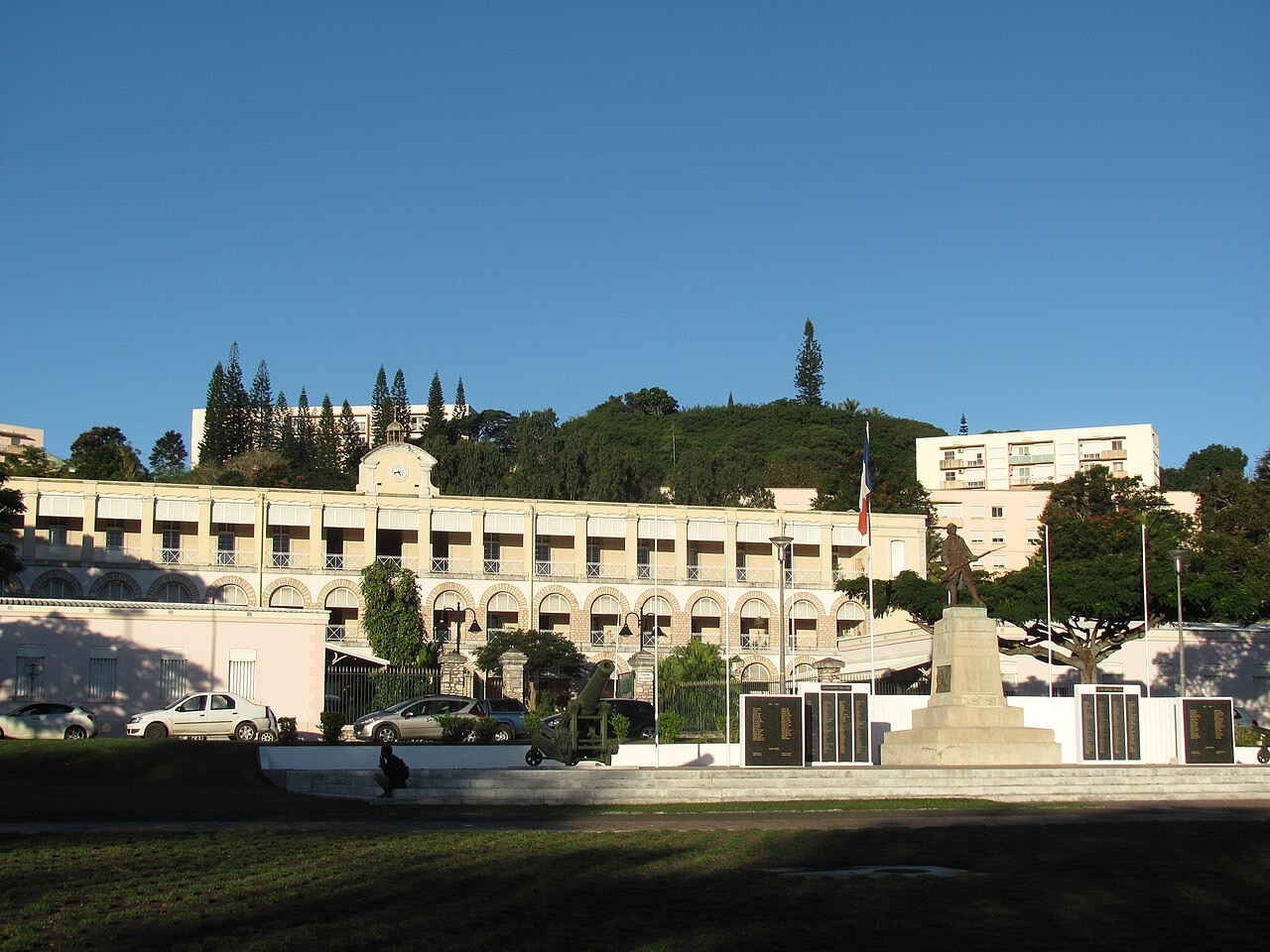
The war can still be felt in two places. The Place Bir-Hakeim, laid out in 1870 for an old barracks, was named in 1945 after the Battle of Bir Hakeim in Libya. There, in 1942, Free French troops held out for two weeks, among them the Bataillon du Pacifique: some 600 volunteers, half from New Caledonia and half from Tahiti, who left Nouméa in May 1941. The Musée de la Seconde Guerre mondiale, opened in 2013, is housed in one of the last prefabricated barracks in the centre, a curved metal “demi-lune”. It tells of the Caledonian volunteers, city life in wartime and the American years.
At the waterfront, the Musée maritime completes the circle. It opened in 1999 in the harbour’s former passenger terminal. About half of the pieces come from the Boussole and the Astrolabe, La Pérouse’s ships, which vanished in 1788 and were later found as wrecks on the reefs of Vanikoro. Divers from Nouméa brought up cannons, anchors, tableware and instruments over several decades. Nearby, the ferries depart for the Loyalty Islands and the Isle of Pines.
There Is More Than This
This is only a sample of what you will come across along the way. The full walk through Nouméa has more stops, a few quiz questions to answer and details you can easily miss without a guide. If you would rather explore the city on your own, you can pick the route in the CityWalkGems app and walk it at your own pace.
- 10 stops
- Marché de Port Moselle start
- ~4,2 km route length
- ~731 m longest stretch
- about 1,5–2 h duration
- Free

