
Porto Alegre is the capital of Rio Grande do Sul, Brazil's southernmost major state, and it is not a city that pushes itself on you. Walk here and you discover that the historic center is compact and that almost every building plays a part in the government, faith or culture of the region. If you are wondering what to do in Porto Alegre, the best place to start is a walk through that center, where the power of the state and the stories of ordinary people lie just a few streets apart.
Government Within Walking Distance
Few cities show so clearly how a state is organized. The Assembleia Legislativa is the legislative branch of Rio Grande do Sul: this is where laws for the entire state are debated and voted on. Its counterpart, the executive branch, sits in the Palácio Piratini on the Praça Marechal Deodoro. Most locals simply call that square the Praça da Matriz, after the cathedral beside it. The palace is still the seat of the state government.
Further north, at the Praça Montevidéu, stands the Paço Municipal, the old city hall from around 1900. Since 2022 it has housed an art museum, the Museu de Arte do Paço. On the way there you pass the Edifício Sulacap at the Esquina Democrática. When it opened in 1949, this office and apartment block was the tallest building in Porto Alegre.
Among all this officialdom stands the Viaduto Otávio Rocha, one of the city's most striking feats of engineering. It lies in the center, where Rua Duque de Caxias crosses one of the great avenues. Lean on the railing and you see traffic flowing in two directions, one road passing over the other.
Play Porto Alegre right in your browser →
Churches and Chapels with Staying Power
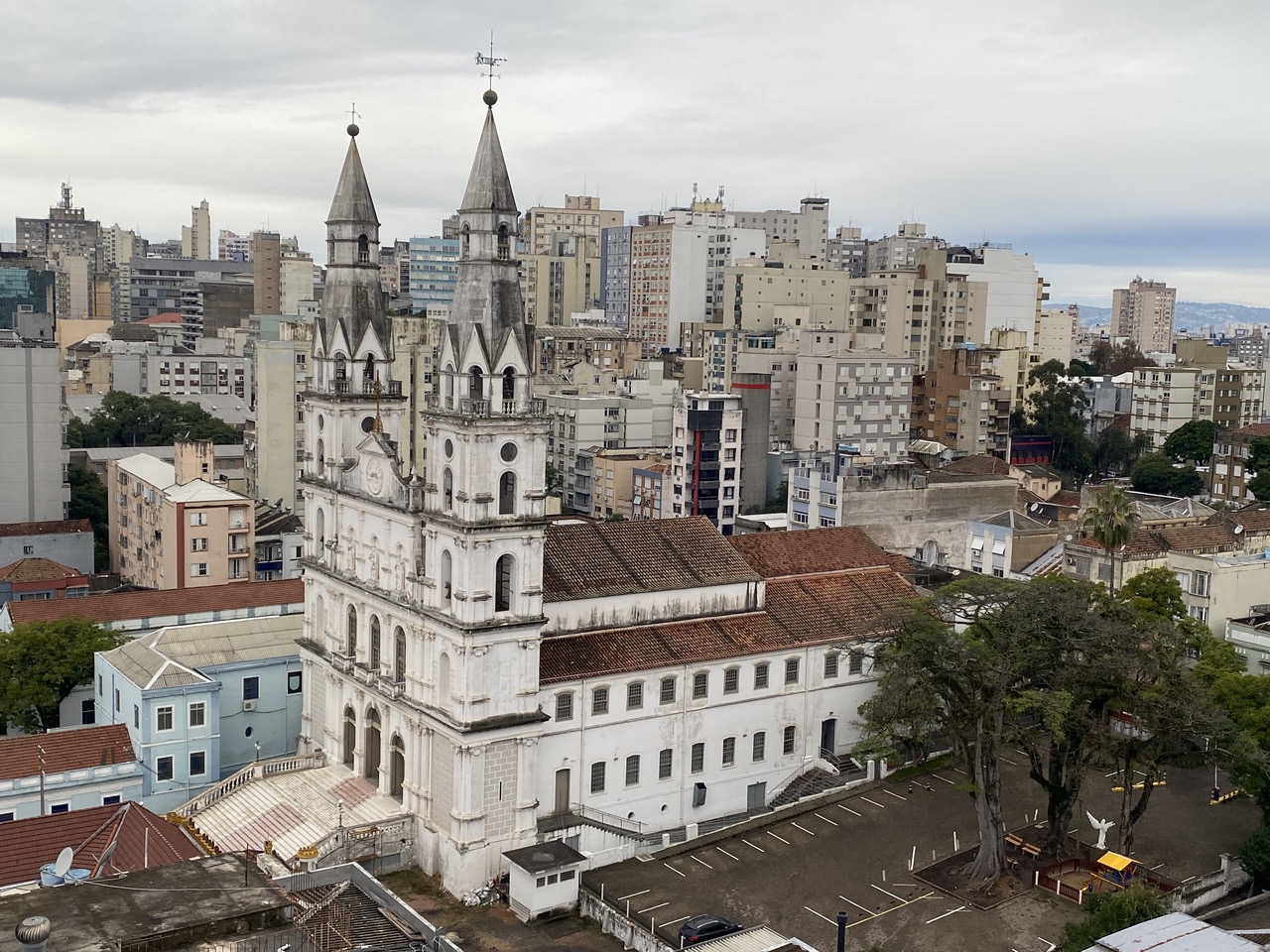
The Basilica Nossa Senhora das Dores is the oldest surviving church in the city. Construction dragged on so long that the facade design changed halfway through. Inside, gilded wood carvings gleam throughout the interior, and life-size Baroque figures of Christ tell the story of the Passion. The church is nationally protected by IPHAN and was elevated to a minor basilica by Pope Francis in 2022.
Smaller, but with an equally long story, is the Capela Nosso Senhor dos Passos. It began in 1819 as a small Baroque chapel. Until the 1960s it was repeatedly altered and expanded, until an eclectic building stood there with a predominantly Neo-Gothic facade. The chapel belongs to the Santa Casa complex, is one of the oldest churches in the city and is on the municipal list of historic heritage. It is a structure you can watch grow through the centuries, without anyone ever having designed it as a whole.
Where the City Cherishes Its Poets and Stages
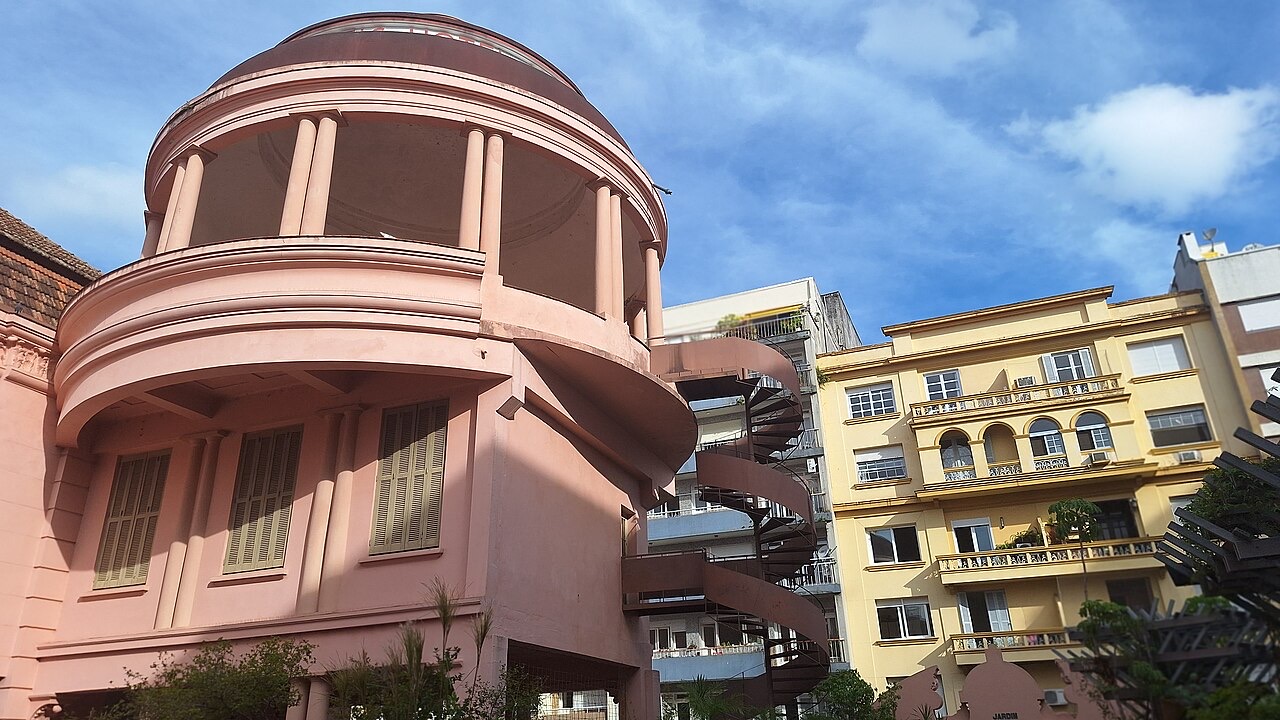
The Casa de Cultura Mario Quintana is perhaps the finest example of how Porto Alegre treats its past. From the 1930s to the 1950s, this building hosted guests such as Getúlio Vargas, João Goulart and the singer Francisco Alves. From 1968 to 1980, the poet Mário Quintana lived here in a hotel room, apartment 217. He came from Alegrete and made this city his own. Since 1990 the building has been one of the largest public cultural centers in Brazil, and it bears his name.
A few streets further on stands the Teatro São Pedro. Its official name is still spelled with an 'h', Theatro, an old-fashioned spelling the house refuses to let go of. It opened in 1858 and is still a living stage in the capital of Rio Grande do Sul.
Culture here is also carried by a bank. Banco Santander runs the Farol Santander, formerly Santander Cultural, in a historic building protected as heritage by IPHAE. Farol means lighthouse, which suits a place that wants to draw people in from the square. If you end the walk at MARGS, the art museum that carries Rio Grande do Sul even in its abbreviation, you will have gained in a few hours a good picture of how this city sees itself: as the capital of a state with a character of its own, where government, faith and art lie close together. The route also passes lively, central spots where you can easily grab a coffee or rest for a moment on a bench.
This Is Just a Taste
What you read here is only part of what the route has to offer. The full walk through Porto Alegre has more stops and more stories than I mention here, plus details you only notice when you are standing in front of them yourself. Want to discover them all at your own pace? Then choose the Porto Alegre walk in the CityWalkGems app and walk from room 217 to the very last door yourself.
- 12 stops
- Start anywhere
- ~3,8 km route length
- ~738 m longest stretch
- about 1,5–2 h duration
- Free

