
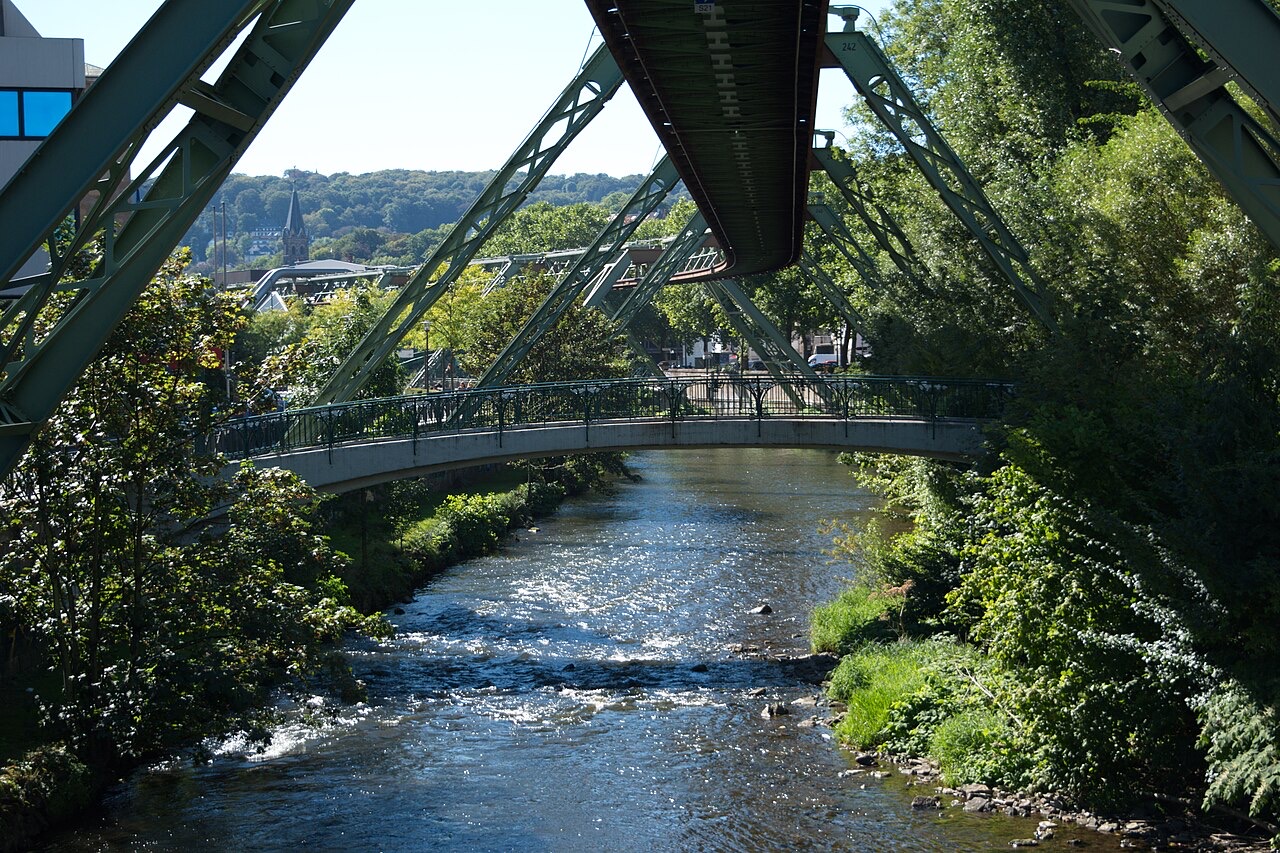
Wuppertal is a city best got to know on foot. The Wupper flows right through the middle of it, Schwebebahn cars glide above the centre, and between the districts, public staircases serve as streets. If you're looking for a Wuppertal city walk that goes beyond a row of façades, Elberfeld, the old heart of the city, offers a route full of small stories: an Art Nouveau footbridge beneath the rails, a theatre that is closed yet still part of the conversation, and a staircase whose name sounds like a carnival hit.
By the Water: A Bridge, a Station and a Staircase of 41 Steps
The start is at the Bismarcksteg, a slender Art Nouveau footbridge over the Wupper. Wrought-iron arches stand at both ends, and the Schwebebahn runs right above your head. Since 31 October 1905 the bridge has carried the name of Otto von Bismarck, the first chancellor of the German Empire. It links the Schlossbleiche with the Islandufer on the other bank.
A little further on you hear the hum of the Schwebebahn at Kluse station, a structure of steel and glass between pillars 266 and 267. On the heritage register it is still listed as "Kluse/Schauspielhaus", after the nearby theatre. It shows right away how closely everything sits together in this city.
Next comes the Elisentreppe: 41 steps between Hofkamp and Elisenstraße. The name has a backstory that sits higher up. On the Hardt, the manufacturer Engelbert Eller had a windmill converted into a lookout tower. With permission from the Prussian crown prince, he named the spot Elisenhöhe, after the prince's wife, Elisabeth. The staircase itself was closed for a week in February 2009 because of frost damage. Even in Wuppertal, winter sometimes gets the better of the city.
Play Wuppertal right in your browser →
Two Churches and a Theatre That Closed Its Doors
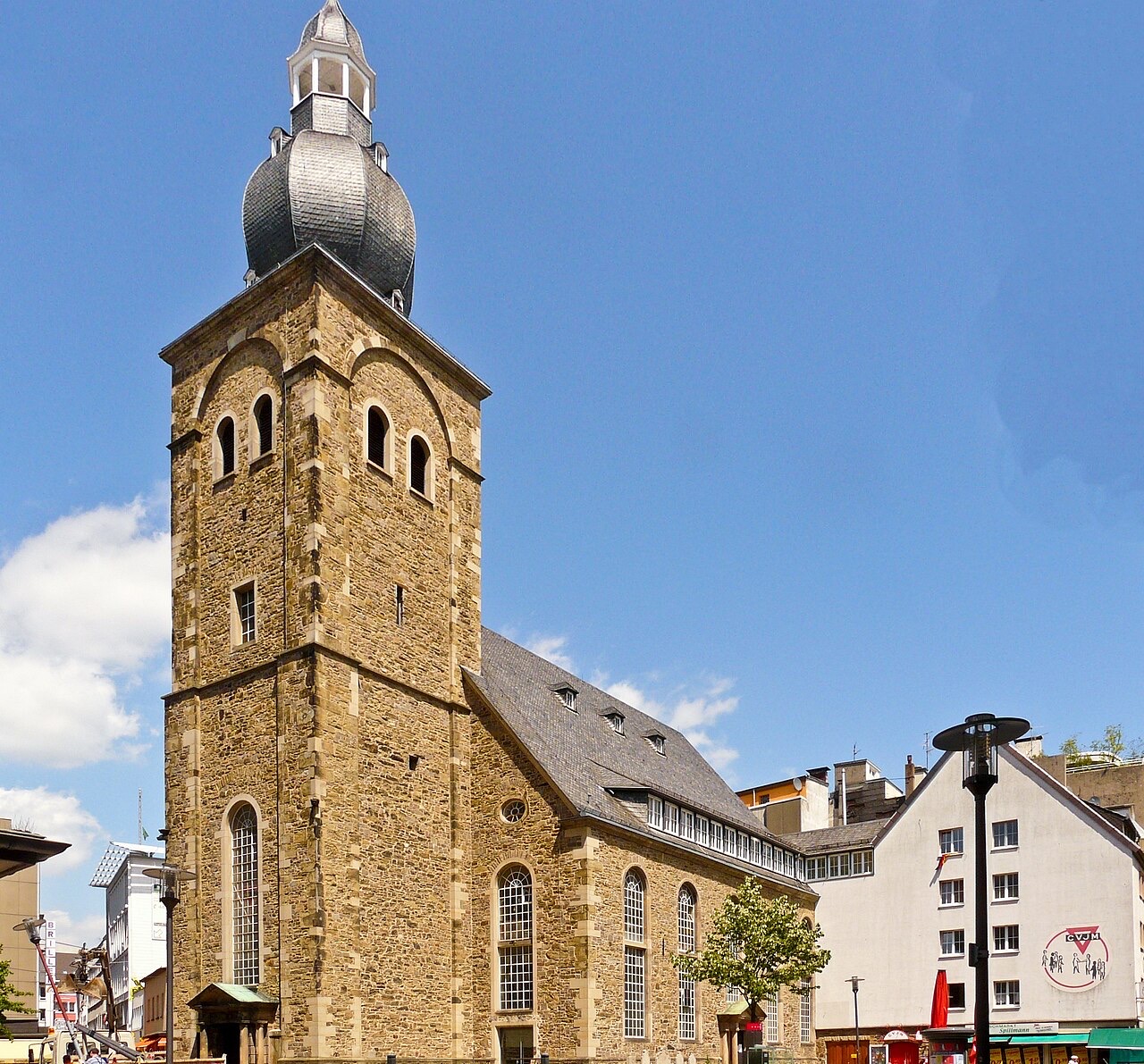
Elberfeld has a remarkable sequence of churches. The Alte reformierte Kirche is the oldest church in the district. It replaced a church that had remained Catholic until the Reformation. Since 2005 it has been called Citykirche Elberfeld and serves as the main Protestant church of the Wuppertal church district.
Only one church follows it in age: the Lutheran Kirche am Kolk. It began as a Baroque building and has been altered and renovated several times, most recently in the 2020s. So two churches of different denominations stand within walking distance of each other, which says something about the history of the city.
Then there is the Schauspielhaus, a building with a date attached: 30 June 2013, the day the theatre closed. Gerhard Graubner designed it, and it was built between 1964 and 1966. It was home to the Wuppertaler Bühnen and to Pina Bausch's company. The city, however, could not afford the necessary renovation. A reopening as a Pina Bausch centre is planned. Anyone walking past today sees a building waiting for its second life.
Art and Cityscape: From French Painters to the Ölberg
The Von der Heydt Museum shows paintings, sculptures and photographs from the 17th century to the present. French painting of the 19th century and modern art form the heart of the collection. The museum also has a painful chapter. Under the Nazis, many works were confiscated as "degenerate art" and sold or destroyed. After the war, the museum managed to fill many of those gaps again.
Look out over the rooftops of the centre and your eye falls on the Elberfeld town hall. Few other buildings shape the skyline so strongly. It was the council hall of Elberfeld, right in the heart of the district.
The most quirky stop on the route is Tippen-Tappen-Tönchen. The name is onomatopoeic: say it out loud and you can almost hear the stairs. In total, 103 steps zigzag 16 metres uphill, from Am Kasinogarten in the Luisenviertel to Gertrudenstraße on the Ölberg. The staircase was built in the 19th century for the working-class neighbourhood. A carnival hit was dedicated to it, and a crime comedy borrowed its name: King Ping – Tippen Tappen Tödchen.
What Else Awaits You
This is just a taste of the walk. Along the way you also pass a basilica, and the route ends at the Historische Stadthalle, and there is more to it than what's written here. The full walk through Wuppertal has more stops and hidden details than I can fit into one article. If you'd like to discover it for yourself, choose the Wuppertal walk in the CityWalkGems app and let the stairs, bridges and churches tell their own story.
- 12 stops
- Start anywhere
- ~4,7 km route length
- ~720 m longest stretch
- about 1,5–2,5 h duration
- Free

