
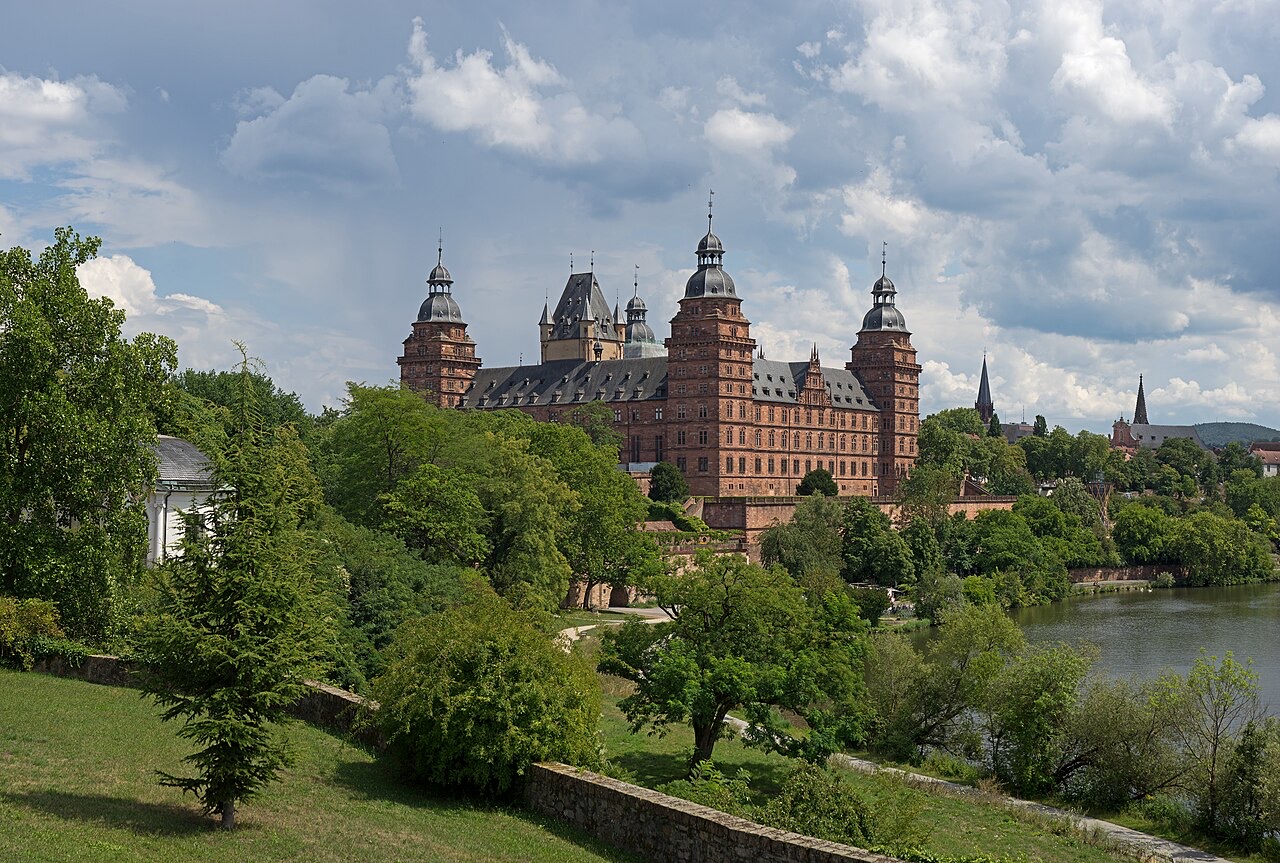
Aschaffenburg lies on the River Main, with the hills of the Spessart rising just behind the town. If you are looking for things to see in Aschaffenburg, you will find a compact old town where archbishops, chapters, tailors, Jesuits and an Expressionist painter have all left their mark. Everything is within walking distance, which is what makes the town so pleasant to explore.
Palace and Court
Start at Schloss Johannisburg. The architect Georg Ridinger from Strasbourg built it between 1605 and 1614. Its warm red colour comes from Odenwald sandstone, quarried near Miltenberg and Obernburg on the Main. Four corner towers of 52 metres frame the square complex. Walk along the façade and you immediately see how great its builders' ambitions were.
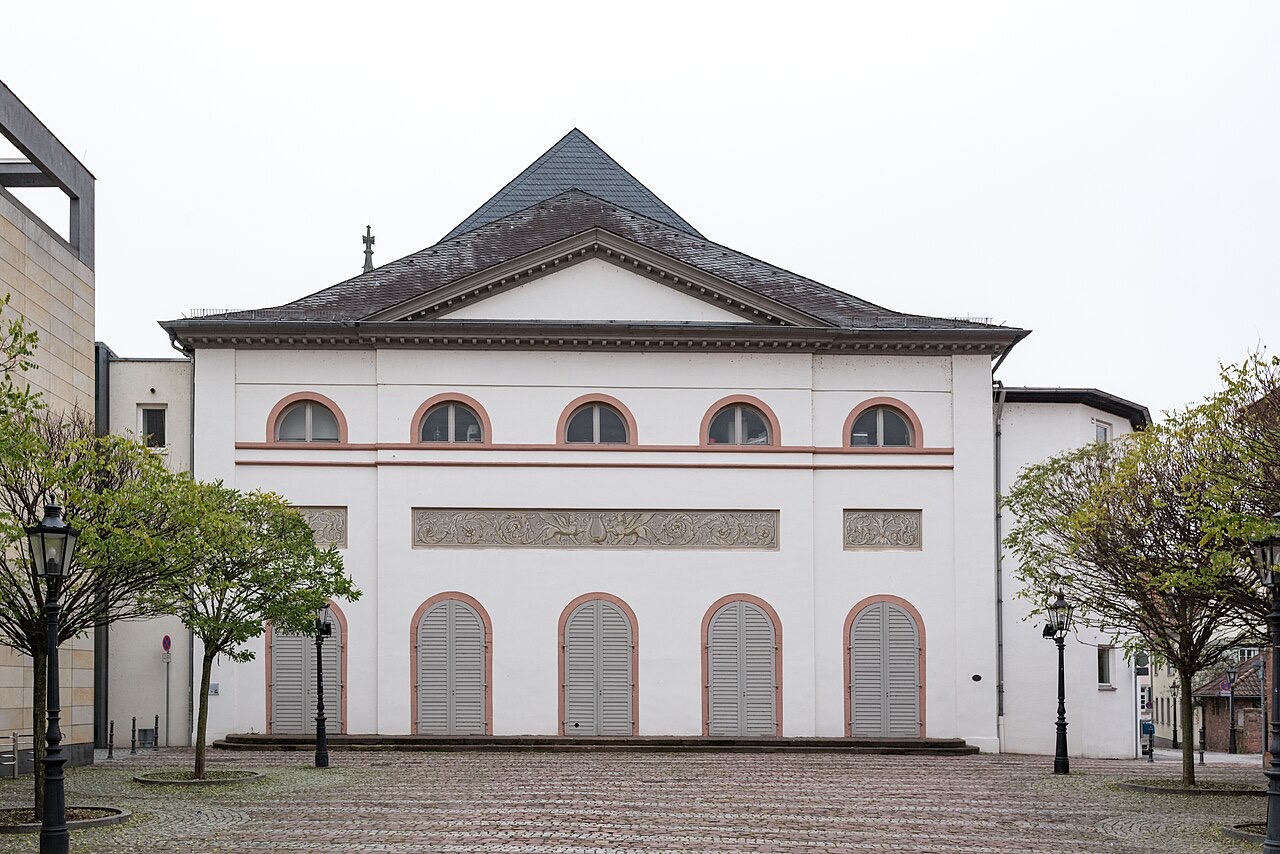
That court culture lives on in the Stadttheater. Prince-Primate Karl Theodor von Dalberg had it built in 1811. Behind the façade is an auditorium painted in the Empire style, regarded as one of the most beautiful in southern Germany. The theatre is still in use, with drama, concerts, dance theatre and cabaret. It is worth checking the programme beforehand.
You will find a very different scale at the Kurfürstliche Schneiderei, a Renaissance house named after the tailors who worked here for the court of the prince-electors. Robes for a great palace, made in a house on a human scale. The contrast with Johannisburg is striking, and that is exactly why it tells you something about how such a court was run.
Churches, Monasteries and Quiet Corners
Each of Aschaffenburg's churches tells a different story. At the Stiftskirche, the word "Stift" reveals who it was built for: a chapter, a community of clergy living by a shared rule. The archive of the Chapter of Saints Peter and Alexander is now housed in the Schönborner Hof. There, insects and archives share one address. The Natural History Museum displays an extensive insect collection along with the minerals and geology of the Spessart, while the municipal and chapter archive and the regional library for the Spessart and Untermain keep their collections there too.
St. Agatha is not a museum piece but a living parish, where Masses, baptisms and weddings are still celebrated. The church is named after Agatha, the martyr from Sicily, and its roots reach back to the Middle Ages.
The Jesuitenkirche, built between 1619 and 1621, has been given a new purpose. Since 1990, the Church of the Holy Trinity has been the town's Kunsthalle, where changing exhibitions now hang on the spot where the Jesuits once preached. In the east wing of the former Jesuit monastery next door you will find the Christian Schad Museum.
Another order left behind a long chapter of history: the Capuchins, a branch of the Franciscans, lived and prayed in the Kapuzinerkirche from 1626 until 2010. Almost four centuries of monastic life ended when the community departed.
Art, a Hospital Chapel and a Roman Villa
Art plays a major role in the town. Ernst Ludwig Kirchner, one of the great names of modern German painting, was born in the Kirchnerhaus. His birthplace is now a museum devoted to him. Changing exhibitions bring together contemporary artists whose themes resonate with his work.
One more church stands near the old town hospital: the Spitalkirche. This small chapel was finished in 1848. A merchant's widow paid for most of it and asked never to be named as the donor. Today a Romanian Orthodox parish celebrates its services there.
The Pompejanum is the grand finale. High above the Main stands a reconstructed Roman villa, modelled on the Casa dei Dioscuri in Pompeii. Mediterranean plants grow around it, some in tubs that disappear in winter. From here you look out over the river, a fitting end point for a walk that runs through four centuries of history.
This Is Just a Taste
What you have read here is only a selection of what Aschaffenburg has to offer. The full walk includes more stops, a question at every stop and details you would easily miss without a guide. If you want to walk the route for real, choose the Aschaffenburg walk in the CityWalkGems app and discover the rest for yourself.
- 12 stops
- Start anywhere
- ~4,4 km route length
- ~634 m longest stretch
- about 1,5–2,5 h duration
- Free

