
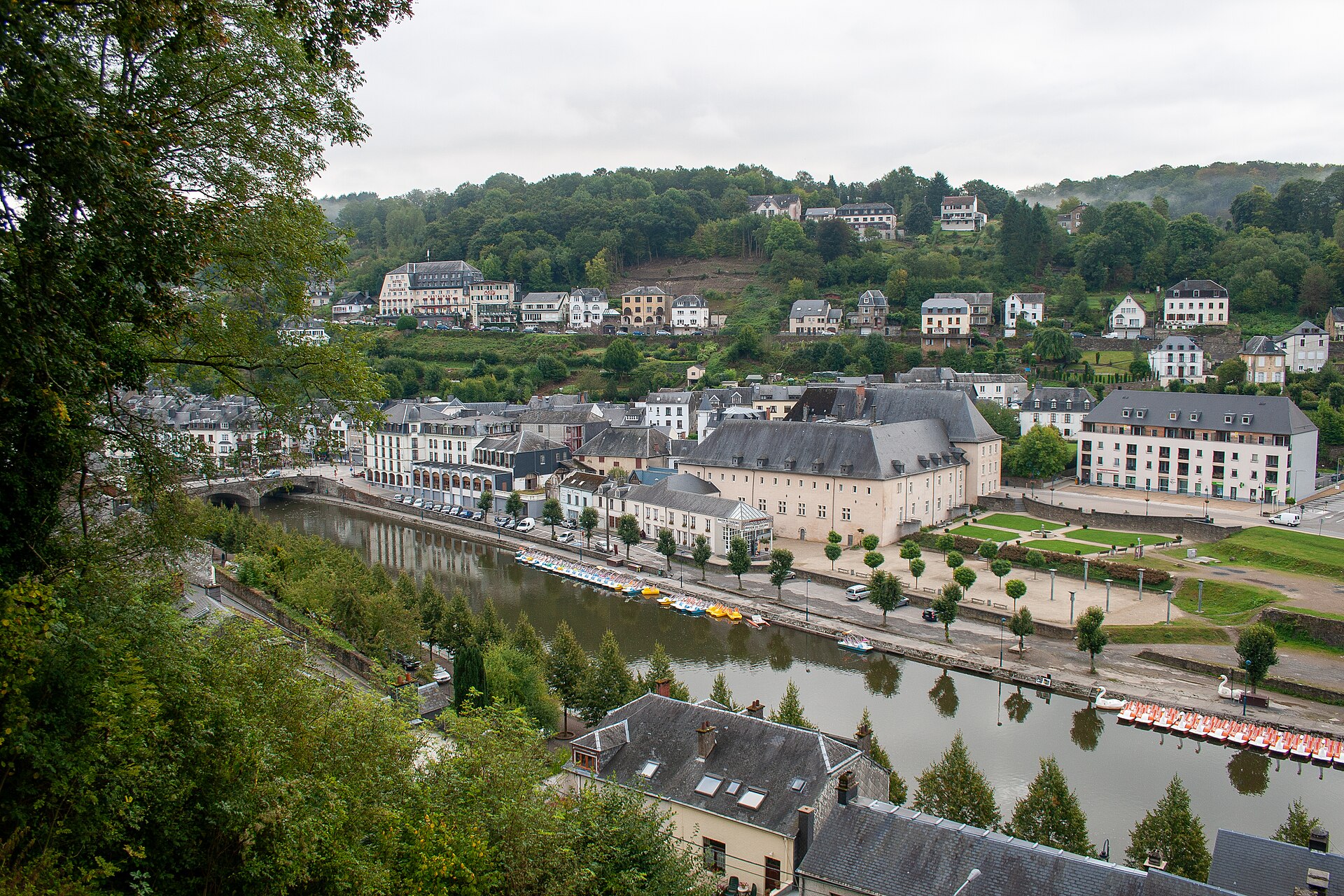
Bouillon lies deeply nestled in the valley of the meandering Semois, wedged between the steep slopes of the Ardennes. Embarking on a walking tour of Bouillon means stepping into a fortified city where water, slate, and centuries-old fortifications dictate the rhythm. From the riverbanks, the air smells fresh with river water and Ardennes broadleaf forest, while high above the rooftops rises a massive castle. This is a city where every bend of the river and every hillside served a clear military and historical purpose, from the early Middle Ages well into the eighteenth century.
The Rocky Ridge and the Crusaders' Legacy
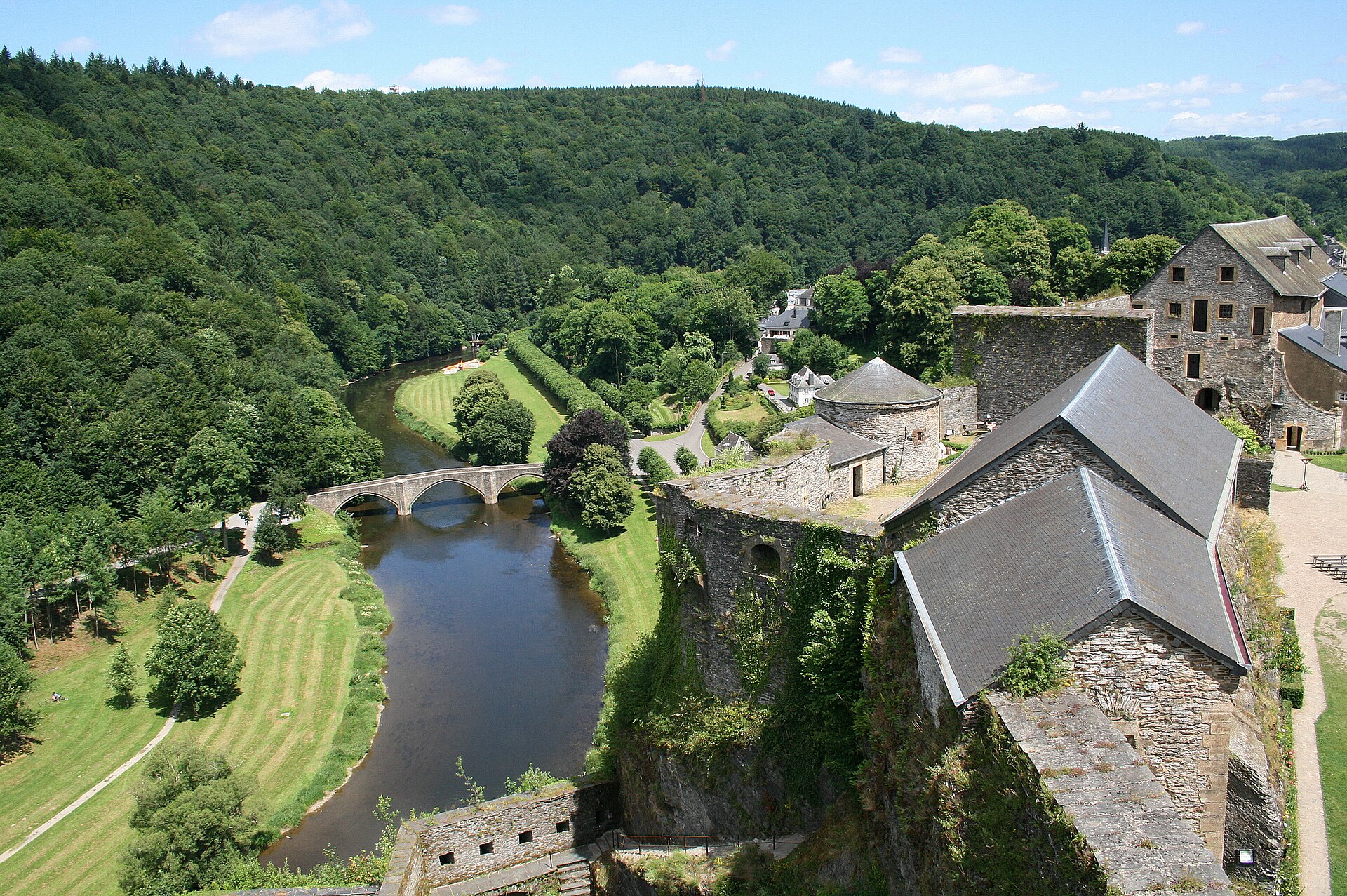
The city's silhouette is entirely dominated by the Château de Bouillon, regarded as one of the oldest surviving feudal castles in Europe. Atop the narrow, elongated rocky ridge, the wind howls freely across the dark slate. The master builders made optimal use of the natural topography: three deep trenches carved directly out of the rock divide the fortress complex into separate compartments. This made it virtually impossible for attackers to capture the castle in a single assault; after each trench, a new defensive line awaited them.
Just before the castle gates lies the forecourt, an area that for centuries served as the only guarded entrance to the fortress. Day and night, guards were stationed here to thoroughly inspect every horse and cart before the wooden drawbridge was lowered. Today, a statue of the crusader stands on this square, looking out over the lower town and the deep gorge of the valley.
Down on the quay, inside a former convent, the Bouillon Medieval Experience recalls the dawn of that crusader history. Here, knights and pilgrims once gathered to prepare for the long, arduous journey to the East. The Duke of Bouillon of that era sold all his worldly possessions to supply his army with provisions and weapons, and to finance the expedition.
French Bastions and Strategic Vantage Points
The Middle Ages were not the only era to leave an imprint on Bouillon. At the end of the seventeenth century, French Marshal Vauban commissioned extensive fortifications to secure the northern French frontier. One of these strongholds is the Bastion de Bretagne. From this vantage point, you look down onto the steep Ardennes slopes encircling the town. Here, Vauban deliberately chose thick earthen ramparts, designed to absorb the devastating impact of incoming cannonballs and shield the posts behind them.
On the opposite side of the defensive perimeter sits the Bastion du Dauphin, a former artillery platform named after the French crown prince. This strongpoint specifically covered the garrison's northeastern flank. From this platform, the artillery commanded the precise river bend along which enemy troops might advance. Where heavy cannons once stood trained on the valley, moss now grows in the deep crevices of the aged masonry.
To understand why this location was of such military value, make the climb up to the viewpoint at La Ramonette. For centuries, this hill served as an advanced observation post; already in Roman times and later during the Middle Ages, watchmen stood here to spot approaching armies well in advance. Up on the heights, the dense canopy muffles the city sounds, leaving mainly the wind whispering through the oak trees. The sweeping panorama reveals how the Semois forms a nearly perfect loop around the ridge, enclosing the fortress city in water on almost every side.
Toll Gates, Dukes, and Tranquil Bridges
Along the riverbanks, stone bridges play a vital role in connecting the city to the surrounding countryside. The Pont de la porte de France stands where the current gently swirls against heavy masonry piers. In bygone days, the official southern approach from France led directly across this bridge. Anyone wishing to enter the fortress was met by a heavily guarded city gate, where merchants and travelers had to pay a toll before passing through with their goods.
A short distance downstream stands the Palais Ducal, with its stately neoclassical facade. Today it serves as the town hall, but in the eighteenth century, it was home to the sovereign dukes of Bouillon from the House of La Tour d'Auvergne. The elegant interior salons mark a turning point in the city's history: the harsh combat of the Middle Ages gave way to the refinement and diplomacy of the Enlightenment.
The riverside route ultimately brings you to the Pont de Cordemois, known locally as the Pont de la Poulie. For generations, this stone bridge served as the rural crossing for travelers journeying to the nearby Abbey of Clairefontaine. Standing midway across the bridge, it is well worth glancing back: from here, you can behold the medieval castle in all its grandeur, towering proudly upon the rocky ridge above the flowing Semois.
This article merely lifts a corner of the veil on Bouillon's illustrious past. The full tour guides you past many more hidden corners, historical anecdotes, and interactive riddles that bring the fortress heritage to life. If you wish to experience the complete walking tour and discover every detail for yourself, you will find the entire itinerary in the convenient CityWalkGems app.
- 9 stops
- Start anywhere
- ~3,7 km route length
- ~767 m longest stretch
- about 1,5–2 h duration
- Free

