
Arrive in Garmisch-Partenkirchen and your eyes will probably go straight up to the mountains. Yet it pays to keep an eye on street level too, because this town is a union of two villages that were once rivals, each with its own parish church and its own story. If you're looking for things to do in Garmisch-Partenkirchen beyond everything Alpine, you'll find painted farmhouses, a composer's villa, Gothic wall paintings and an inn with a military past. Exploring on foot gives you the best view of how these layers fit together.
Two villages, two church traditions
The clearest symbol of this dual identity is the Rathaus, or town hall. It went up in 1935 to mark the unification of Garmisch and Partenkirchen. Architect Oswald Bieber chose a restrained Alpine Heimatstil, a regional vernacular style, and Josef Wackerle painted the façades. At ground level you walk through an open hall, while on the roof sits a ridge turret with a clock that takes a moment to spot.
On the Garmisch side, the church story revolves around St Martin. The Alte Kirche St. Martin, the old church, was once the only parish church for the entire upper Loisach and Isar valleys, the mother church of all the surrounding parishes. That is a lot of weight for one building. Romanesque and Gothic architecture mingle here, and if the door is open, you can still see substantial remains of Gothic wall paintings inside.
The Neue Pfarrkirche St. Martin later took over the role of parish church. It is worth visiting both, precisely for the contrast: the Baroque interior of the new church feels light beside that of its Gothic predecessor. Every November, children all over Bavaria carry lanterns in honour of St Martin, the church's patron saint.
Partenkirchen has its own parish church, Maria Himmelfahrt (the Assumption of Mary), at Ludwigstraße 46. It belongs to the Werdenfels deanery of the Archdiocese of Munich and Freising, is a listed monument and offers a quiet moment away from the bustle of the street.
Façades, wine and a mountain path
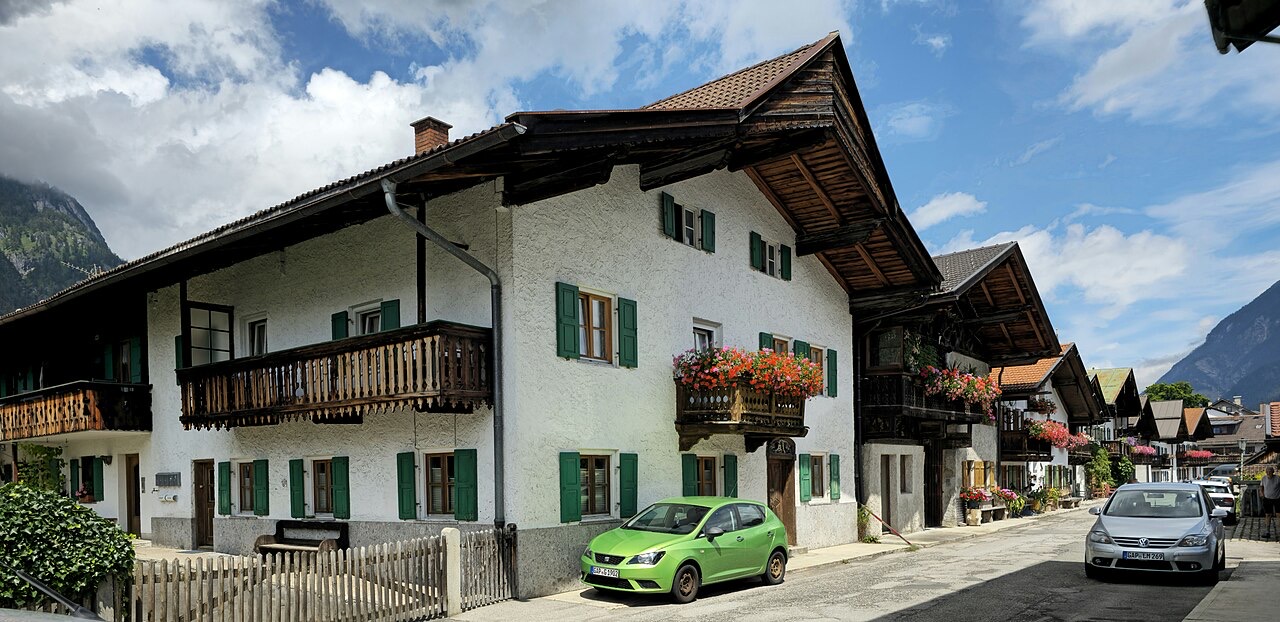
On Frühlingstraße, literally Spring Street, a row of old farmhouses with carved gables and wooden balconies has kept its village look. At number 7 stands a villa from 1921 with murals and carved house figures. It is a favourite photo spot, so take your time.
In Partenkirchen, Ludwigstraße is the historic heart. It follows the Roman road from the Brenner Pass to Augsburg. After the fires of 1811 and 1865 it was rebuilt, and today its eastern part is protected as an ensemble: whole rows of houses are protected together. The streetscape itself is the monument.
One of the best stories belongs to Haus zum Husaren. Wine has been served here since as early as 1611. In 1800, French hussars and Bavarian infantrymen moved into the house, and the landlord soon found them a heavy burden. His solution was practical: he guided the troops along a path through the Wetterstein Mountains into the Leutasch Valley. That route is now called the Franzosensteig, the Frenchmen's Path. Later the house welcomed grander guests, including kings of Bavaria, Saxony and Württemberg.
If you'd like to learn more about everyday life in this valley, Museum Werdenfels is the place to go. The region takes its name from Burg Werdenfels, a castle whose ruins still stand on a slope north of Garmisch.
The twentieth century, and a view from above
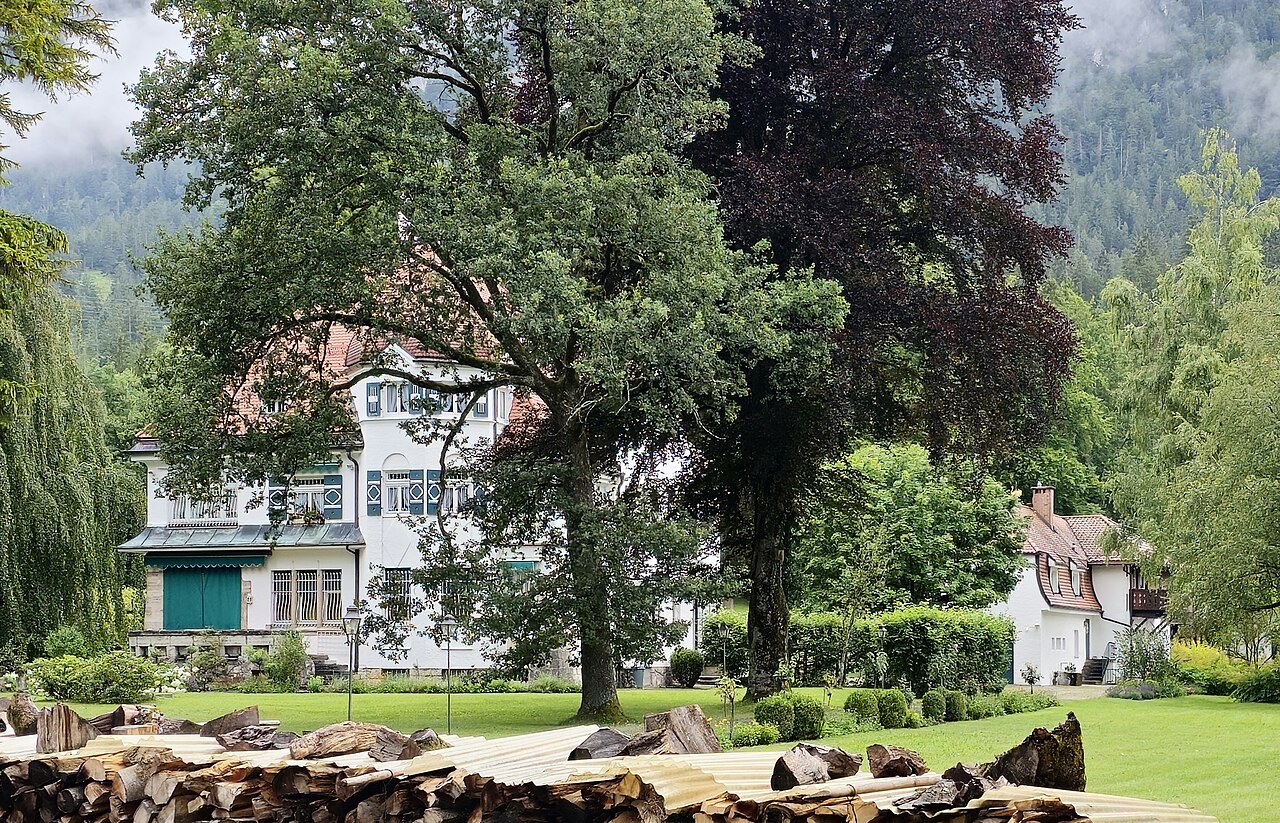
Richard Strauss, composer of Salome and Der Rosenkavalier, lived in Garmisch and died here in 1949. His villa is still private, so you view it from the street, with the mountains behind it.
His name crops up again at the Kongresshaus, at the entrance to the Michael-Ende-Kurpark. Since 1964 it has included a concert hall named after Strauss. The largest event venue in the Bavarian Alps also has a troubled history: it began in the mid-1930s as a festival hall, was used for official occasions during the 1936 Winter Games and later for Nazi rallies.
Above Partenkirchen stands the pilgrimage church of St. Anton. A Franciscan friary was attached to it in 1935. In 2019 the order decided to give the friary up. From here you look out over the rooftops, framed by mountains. It is a good place to see how the town sits in the landscape and to piece together the stories from below.
Set out for yourself
What you've just read is a selection from a walk that has even more in store. Along the way you'll find extra stops, questions to answer and details you could easily walk straight past without a clue to guide you. Curious about what else Garmisch and Partenkirchen have to tell you? Choose the city walk in the CityWalkGems app and go and find out on the spot.
- 12 stops
- Strauss-Villa start
- ~5,4 km route length
- ~907 m longest stretch
- about 2–2,5 h duration
- Free

