
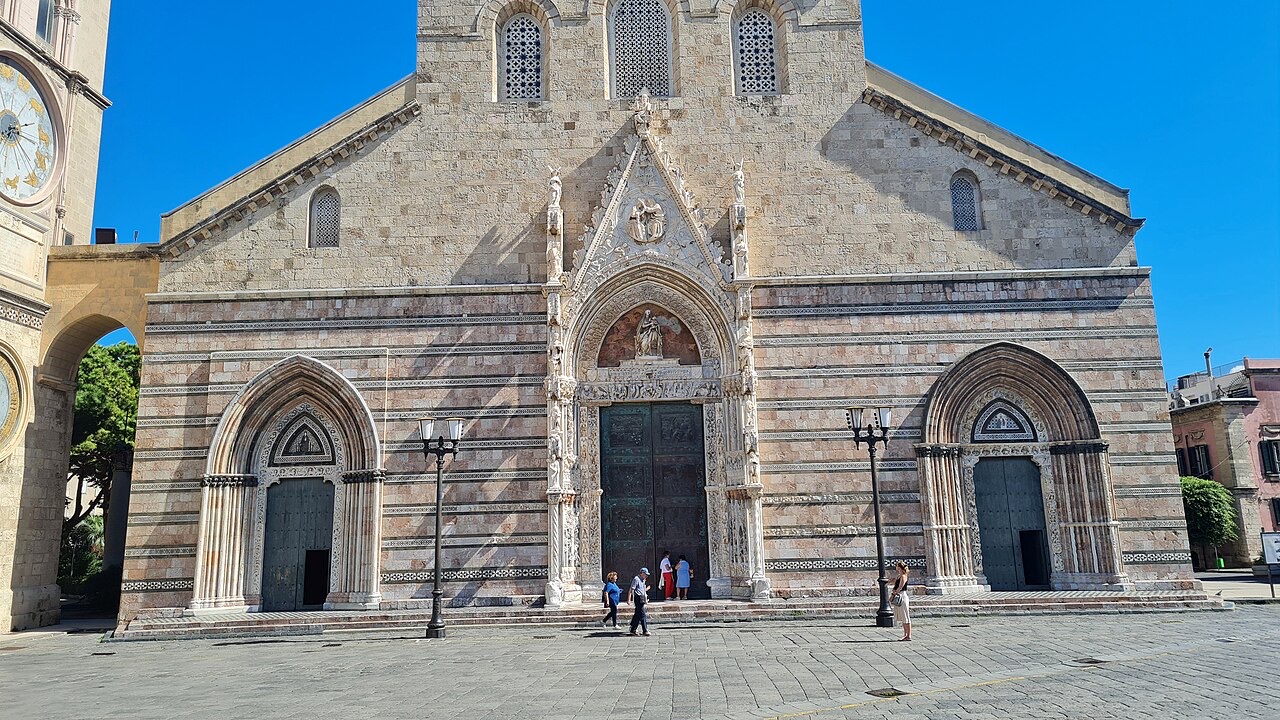
Say Sicily and most people think of Palermo, Taormina or Etna. Messina is more often just a port of passage, the city where the ferry docks. That's a shame, because anyone who lingers here finds a city with Norman churches, Spanish and Catalan traces, fountains that have moved from their original spots, and a theatre bigger than any other regional theatre on the island. A walking tour of Messina naturally begins at the cathedral, and it's not a bad place to sharpen your eye.
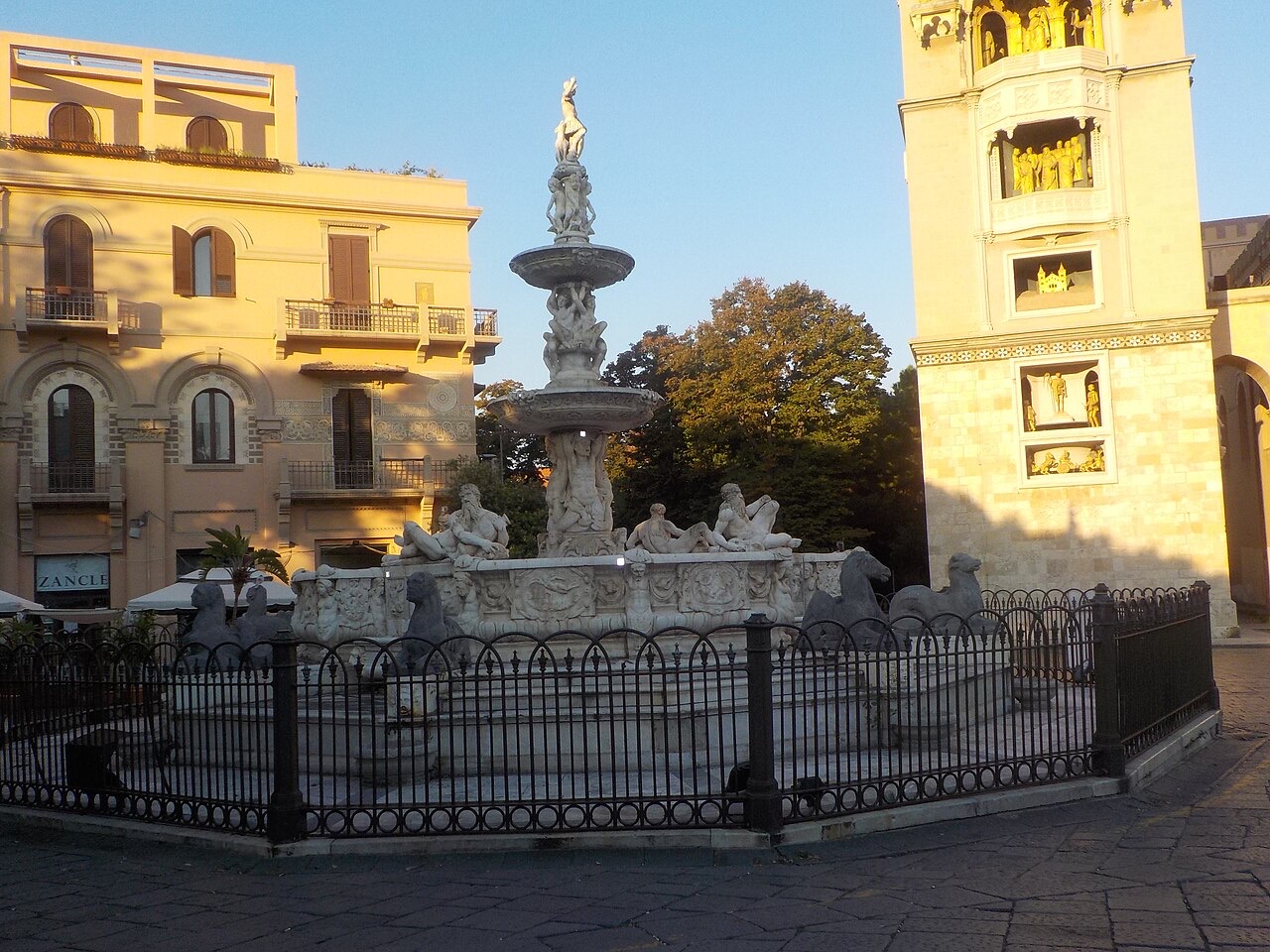
Around Piazza del Duomo: Organ, Giant and City Hall
The Duomo di Messina stands on a broad square that gives its façade and bell tower plenty of room. Inside is the second-largest pipe organ in Italy. In June 1947, Pope Pius XII raised the church to the rank of minor basilica. On the same square, the Fontana di Orione shares the space with the cathedral. Giovanni Angelo Montorsoli created the fountain together with Domenico Vanello, and it is named after Orion, the giant hunter of Greek myth.
Continue into the city and you reach the Teatro Vittorio Emanuele II, Messina's most important theatre. No other regional theatre in Sicily has more seats. Its name refers to the first king of unified Italy. A little further on stands Palazzo Zanca, which is not a museum: it is the seat of the city government. Here, day after day, decisions are made about paving, squares and benches.
In between lies the Galleria Vittorio Emanuele III, built from 1924 to 1929 to a design by Camillo Puglisi Allegra. In southern Italy, only the Galleria Umberto I in Naples is of the same type. The designers drew inspiration from the Sicilian eighteenth-century idiom, so look up as you walk through.
Fountains and Quiet Little Squares
Messina has more fountains than you might expect, and some lie away from the crowds. On Piazza Basicò stands the Fontana Falconieri, made by Carlo Falconieri, after whom it is still named. Few visitors come this far, so it is peaceful. The Fontana di Gennaro has a little square of its own between Corso Cavour and Via XXIV Maggio. It originally stood at the crossing of the Corso with Via del Collegio and returned to view after restoration in 2015. Locals simply call it the fountain of Gennaro.
The churches also fit this calmer rhythm. The Chiesa di Montevergine on Via XXIV Maggio belongs to the archdiocese and is under the protection of the Madonna della Lettera, the city's very own Madonna. The Santuario di Montalto was first the church of a Cistercian monastery, known as Santa Maria dell'Alto. Today it is dedicated to the Madonna di Montalto.
Norman, German, Catalan: The Layers of Messina
The oldest layers are found in two churches. Santa Maria Alemanna on Via Sant'Elia owes its name to an old Italian word for German. It has preserved its original framework intact and is considered the highest expression of its style in the whole Mediterranean.
Santissima Annunziata dei Catalani probably stands on the ruins of a Greek temple to Poseidon. In the 12th century, under Norman rule, the church rose here. Arabic, Byzantine and Roman elements blend in the architecture, and the apse is unusually well preserved. The name comes from a brotherhood of Catalan merchants of the late 15th century. The building survived the earthquake of 1908, which is far from a given in a city that was so badly hit.
A counterpart from another century is the statue of Don John of Austria. Messina ordered it in 1572, barely a year after his victory of 7 October 1571. Andrea Calamech finished it in 1573. It has been moved several times and has stood here since the rebuilding after 1908.
More Than a Taste
This article covers only part of what you will come across along the way. The full walk through Messina has more stops, quiz questions to answer and details you only notice when you look for them. If you want to discover them yourself, choose the Messina walk in the CityWalkGems app and explore the city at your own pace.
- 12 stops
- Start anywhere
- ~4,1 km route length
- ~613 m longest stretch
- about 1,5–2 h duration
- Free

