
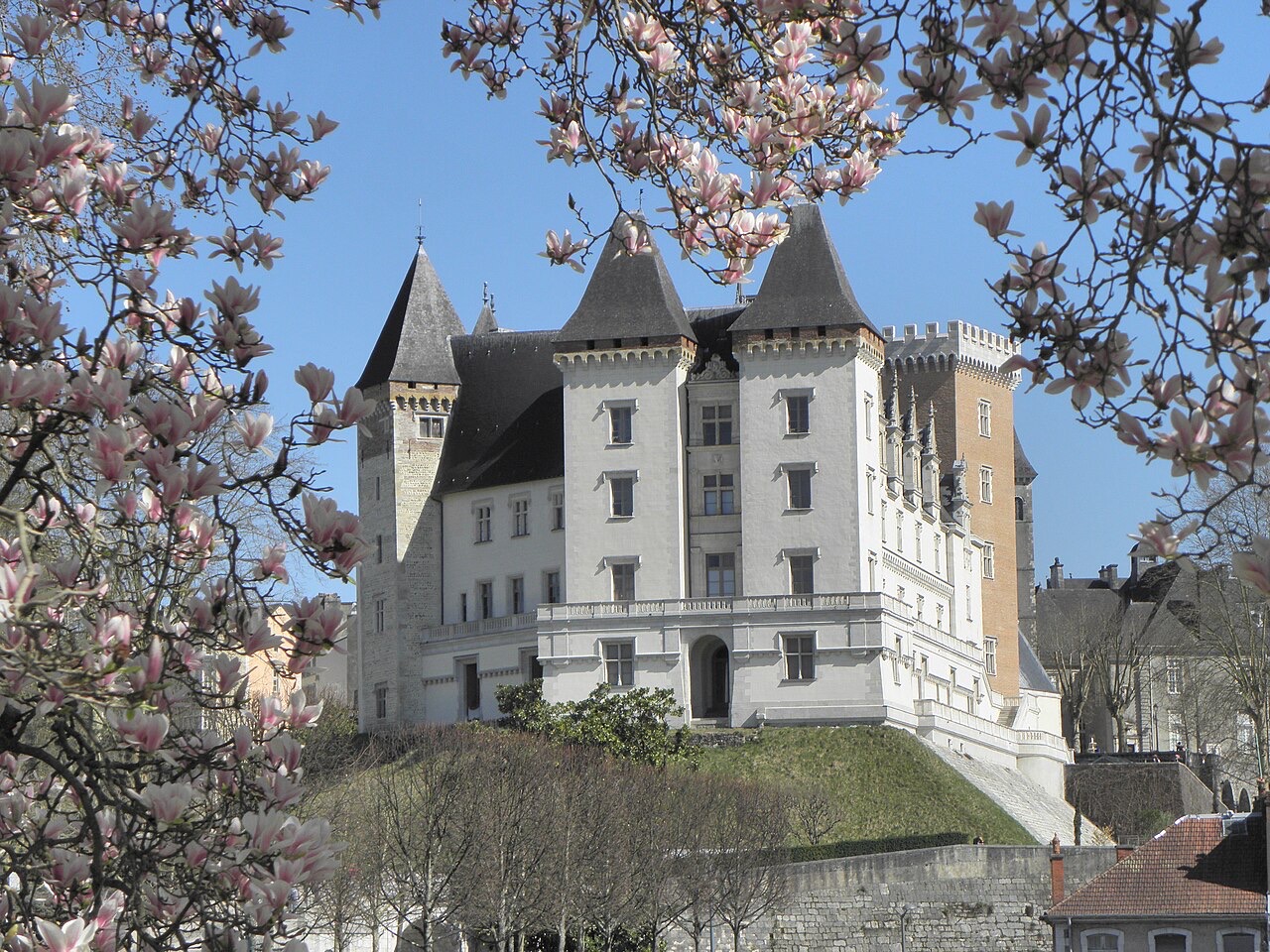
Pau is a city with a striking profile: a castle, a boulevard perched on an edge, and a valley opening up below. A walking tour of Pau takes you past palaces and squares, but also through a ravine where a stream disappeared beneath the street. On one compact route you will meet kings, a marshal, a parliament and a French Spiderman.
The castle and the King of Navarre
Everything begins at the Château de Pau. On 13 December 1553, a baby was born within these walls who would later become Henry IV, King of France and Navarre. In the 19th century Louis-Philippe and Napoleon III had it restored. It has been protected as a Monument historique since 1840, and today it is the Musée national du Château de Pau.
This royal history is visible throughout the city itself. Place Royale carries it in its name: a royal square in the city where Henry IV was born. Take a moment to look around, because one of Pau's most important public buildings overlooks it.
At the other end of the route stands the Parlement de Navarre. The building was constructed in 1585 as Pau's palace of justice and became the seat of the Parlement de Navarre, which Louis XIII founded in 1620 after Navarre and Béarn were joined to France. Today it is used by the departmental council. Four centuries of Pau in a single loop, and one of the finest views of the walk lies right in front of you.
Boulevard, funicular and town hall
The Boulevard des Pyrénées is where Pau shows off its setting. The promenade sits at the same height as the castle and the city centre, while below it the valley of the Gave de Pau lies open. The name reveals which mountain range the boulevard looks toward. A small funicular, the funiculaire, bridges the difference in height. If you arrive at the bottom, it is the quickest way back up into the city.
The town hall on Place Royale has its own story. It was built between 1854 and 1862, and from 1878 the municipal services moved in. Pau is still governed from this building. In 2000, Alain Robert, nicknamed the French Spiderman, free-climbed 15 metres of its façade solo, without a rope.
Hédas and the churches: the city at eye level
The Quartier du Hédas is perhaps the most surprising neighbourhood. Here you stand in the ravine of the old Hédas stream, 6 to 20 metres deep, whose water now flows entirely underground. It was once the district of craftsmen, cabarets and inns, with façades made of pebbles from the streambed. For a long time the area had a bad reputation. Since its renovation in 2017, it has become one of the liveliest corners of Pau.
Where the district ends, another story begins at the Musée Bernadotte. It follows the life of Jean-Baptiste Bernadotte, who became a Marshal of the Empire and went further than almost anyone: all the way to Sweden and Norway.
The route also includes places that are easy to walk past. The Protestant temple at 21bis Rue Serviez has stood there since 1840. Construction took two years, starting in 1838, and was paid for by a Scottish duchess. Today the parish belongs to the United Protestant Church of France. A little further on, the Catholic Église Saint-Jacques bears the name of the patron saint of pilgrims, right in the bustle of the city centre. And close to the gate of the castle district stands the Église Saint-Martin, named after the soldier-saint famous for sharing his cloak. From there, the castle is only a short walk away.
A taste of the route
This article covers only part of what you will come across along the way. The full walk through Pau has more stops, quiz questions and details that you only notice once you are standing there yourself. If you want to walk the route for real, choose the Pau walk in the CityWalkGems app and discover what was left unmentioned here.
- 12 stops
- Start anywhere
- ~4,1 km route length
- ~641 m longest stretch
- about 1,5–2 h duration
- Free

