
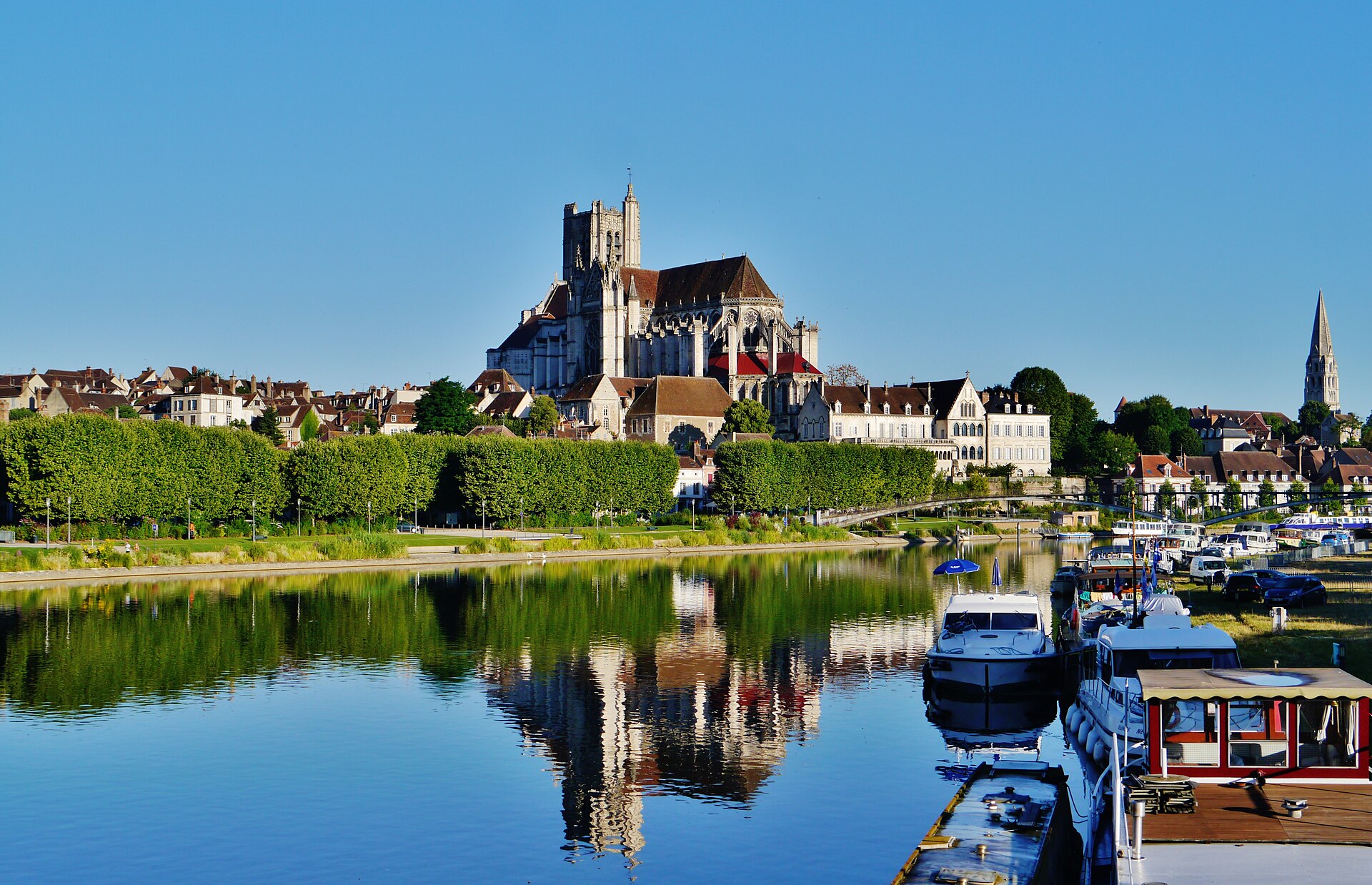
Perched on a ridge above the Yonne River, Auxerre presents a striking silhouette of towers and historic rooftops. This Burgundian city has largely preserved its medieval street plan, allowing visitors to wander effortlessly from one era to another. Anyone embarking on an engaging walking tour of Auxerre quickly realizes that history remains vividly tangible in its streetscapes: from Carolingian wall paintings and Gothic pointed arches to enduring memories of a thriving river trade.
Medieval Jetting and the Mechanics of the Upper Town
The ridge is dominated by Saint-Étienne Cathedral. In the forecourt, the building's asymmetry is immediately striking. While the north tower rises high above the historic skyline, adorned with Gothic pointed arches, the south tower entirely lacks its upper section. During the sixteenth century, the Wars of Religion and chronic financial shortages halted construction for good, leaving the façade incomplete to this day.
Not far from the cathedral, the network of lanes plunges deep into the Middle Ages. On Rue Fécauderie, at number 23, stands an exceptional fifteenth-century timber-framed house with exposed oak beams. The building illustrates the building technique known as jettying: each upper floor projects outward over the narrow street. Within the cramped city walls, residents used this ingenious method to gain precious square meters of living space.
A little farther on, the Tour de l'Horloge serves as a prominent landmark. This gate tower originally formed part of Auxerre's defensive walls. In 1483, the townspeople commissioned an astronomical clock to be installed upon it. Walking beneath the stone arch, you can still hear the ticking of this centuries-old mechanism. Two separate hands indicate both the course of the sun and the current phases of the moon.
On the pavement near the square, a bronze statue commemorates a colorful resident: Guillaume Rousselle, better known as Cadet Rousselle. This eighteenth-century court officer was notorious in town for buying strange, crooked properties. His eccentric lifestyle inspired a satirical folk song that was picked up by French revolutionary soldiers and spread throughout the entire country.
Play Auxerre right in your browser →
Commemoration, Quiet, and Bourgeois Elegance Along the Boulevards
Where the outer defensive ring once stood, broad boulevards now encircle the old center. Along Boulevard Davout stands the Monument aux Morts. Its sculpted figures create a solemn memorial to local citizens who lost their lives during the great conflicts of the twentieth century. The square surrounding the monument offers a quiet interlude within the urban fabric, inviting a moment of quiet reflection.
The boulevards also lead to sites highlighting Auxerre's cultural heritage. On Rue d'Égleny, the gates open to the Leblanc-Duvernoy Museum, housed in an elegant eighteenth-century mansion. Inside lies the subdued atmosphere of a refined bourgeois home, preserving rare Beauvais tapestries, historical ceramics, and an antique musical instrument collection. Nearby, the Muséum d'Auxerre features a natural history collection set within a nineteenth-century botanical garden, complete with mature trees and flowerbeds just outside the stone town core.
Tucked away near the town center is the Passage Soufflot. Designed with nineteenth-century architectural details, this covered arcade links two streets and honors Jacques-Germain Soufflot. The renowned architect was born near Auxerre and gained worldwide acclaim for designing the Panthéon in Paris.
Carolingian Legacies and Riverboat Lore on the Yonne
Heading back toward the river, the Tour Saint-Jean catches the eye. This freestanding Romanesque tower, crowned by a twelfth-century stone spire, survived the demolition of the former abbey church's porch. Below ground lies one of France's greatest historical treasures: Carolingian crypts housing rare frescoes that date back to the ninth century.
At the foot of the hill, the route reaches the banks of the Yonne. Place Saint-Nicolas exudes a distinctive atmosphere, shaded by plane trees that cast soft shadows across historic facades. For centuries, this was the central gathering place for bargemen and riverboatmen, who venerated Saint Nicholas as their patron saint on the water. From this very square, massive timber rafts were floated downstream along the Yonne and Seine to fuel Paris with firewood.
Today, the Quai de la Marine is a vibrant riverside promenade. Where hundreds of wooden barges once docked laden with grain sacks and wine barrels from the Burgundian hinterland, lively café terraces now overlook the gentle current reflecting the upper town's spires. From the bridge, a statue of Paul Bert keeps watch over the river. As a physiologist and Minister of Education, this Auxerre-born statesman laid the foundations for free and secular public schooling in France. His statue marks a scenic vantage point overlooking the quays and the river.
This selection of highlights reveals only a fraction of what Auxerre has to offer. The complete route guides you through many more hidden passages, historical tales, and architectural treasures to discover at your own pace. Open the CityWalkGems app, select the Auxerre walking tour, and let yourself be guided along every remarkable sight in this historic town on the Yonne.
- 12 stops
- Start anywhere
- ~3,7 km route length
- ~865 m longest stretch
- about 1,5–2 h duration
- Free

