
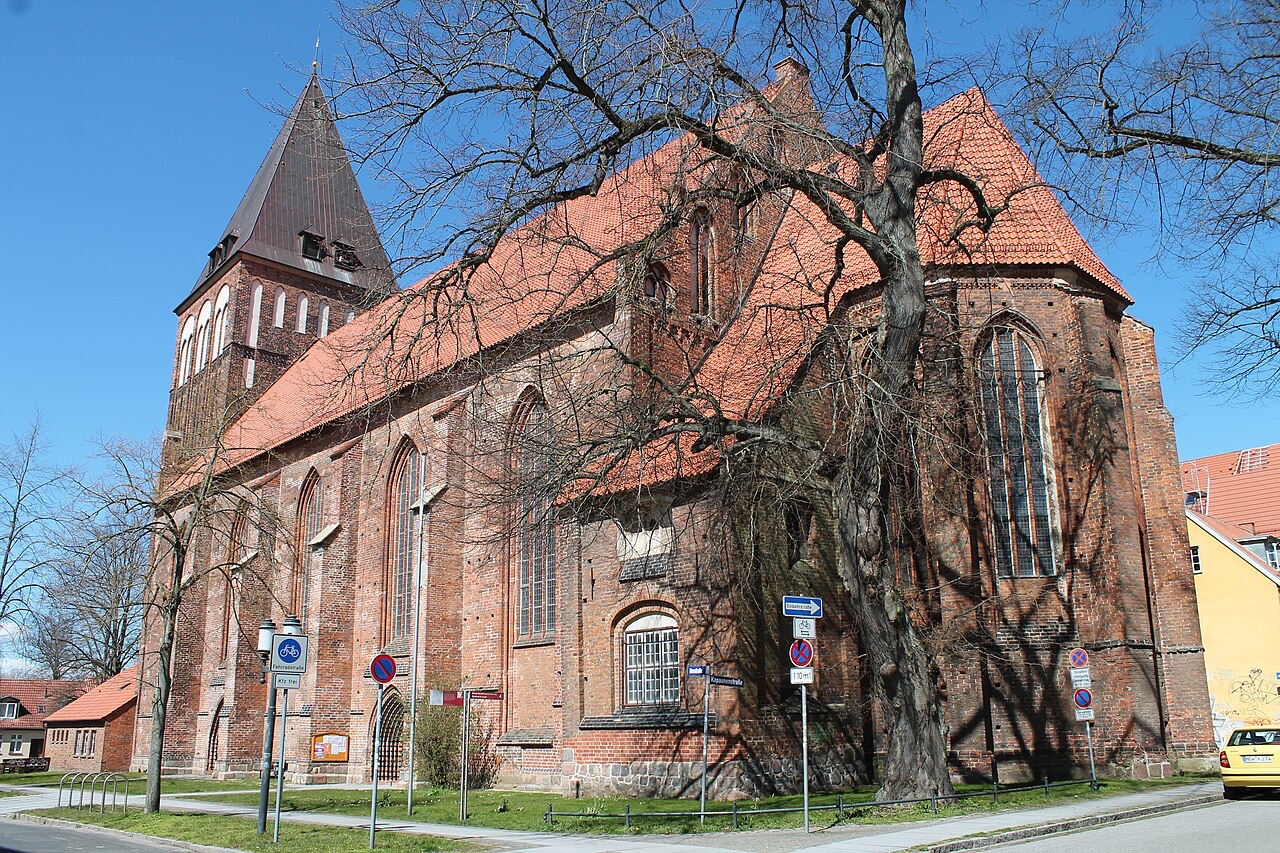
Greifswald is not a town that clamors for attention, and that is exactly what makes it worth visiting. On Germany's Pomeranian coast you will find a university town with a Hanseatic past, three great brick churches, a harbor full of historic ships and a painter who grew up here and helped shape German Romanticism. If you are looking for the sights of Greifswald, you can do most of them comfortably on foot: distances are short and the highlights lie close together. Here is a selection of what you will come across along the way.
Churches, brick and a pilgrim's name
A walk here logically begins at a church. St. Jacobi carries the Latin genitive of Jacobus in its name: the church is dedicated to Saint James. It is the smallest of the three medieval town churches, which is why locals call it little Jacob. A modest start, but one with more than seven hundred years of history.
Greifswald has three great town churches. St. Marien was the first, older than the cathedral, and stands in the tradition of North German brick Gothic. With some 3,200 members, the Protestant congregation there is the largest in town. The icon of the skyline, however, is the Dom St. Nikolai, the Wahrzeichen (landmark) of Greifswald. From 1947 to 2012 it was the main church and bishop's seat of the Pomeranian Evangelical Church. The regional bishop for Mecklenburg and Pomerania still preaches here today.
On the southern edge of the old town you will also find St. Joseph, the Catholic provostry church. It is a neo-Gothic brick building dedicated to Joseph of Nazareth. Traffic heading for the station rolls right past it, a good reminder that Greifswald is a living town and not an open-air museum.
A university town with a memory
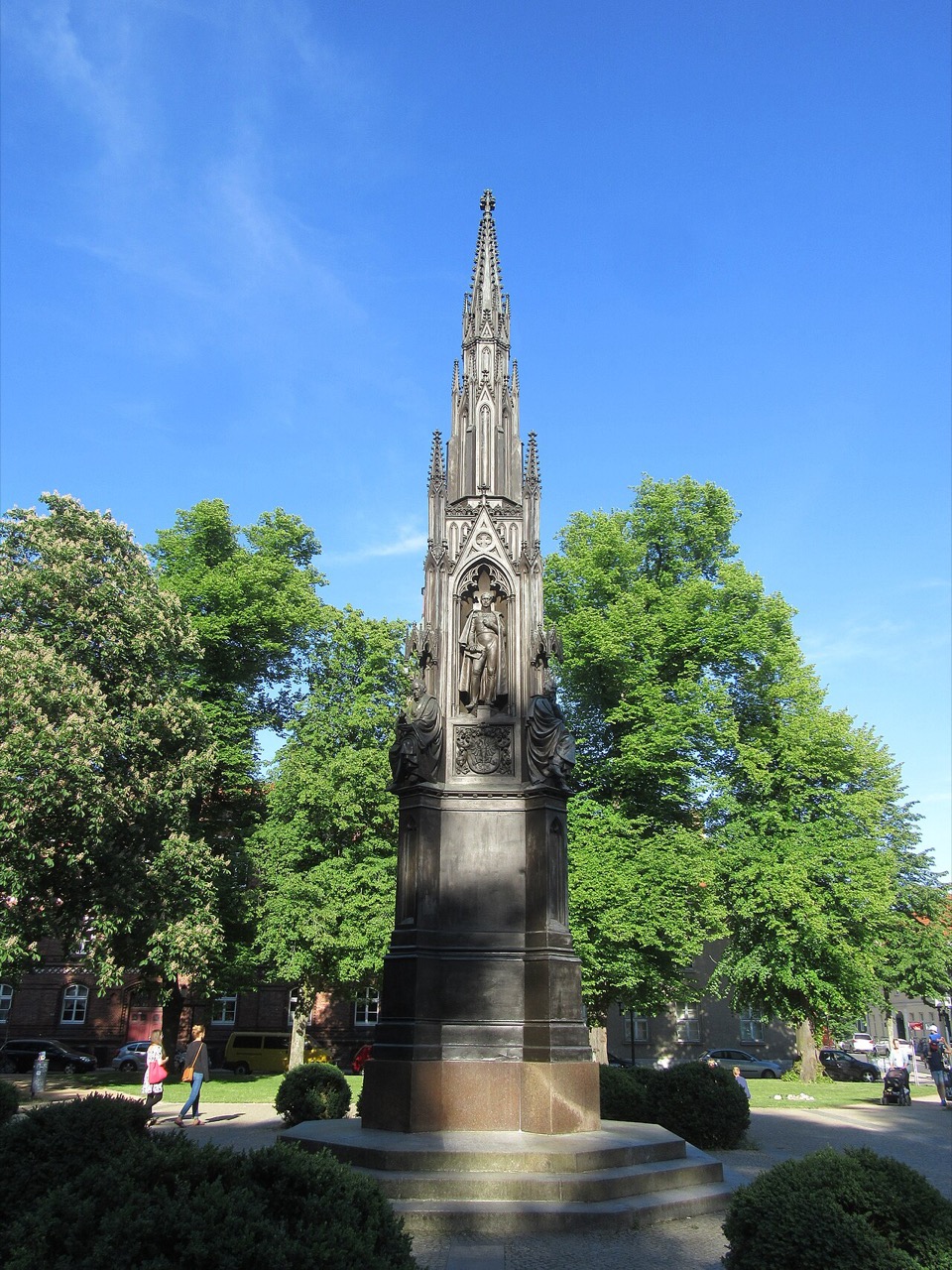
The Rubenow Monument shows how seriously Greifswald takes its university. This slender 12.55-meter finial of galvanically bronzed zinc casting is the largest free-standing one of its kind in Germany. It was unveiled on 17 October 1856 in honor of Heinrich Rubenow, mayor and co-founder of the university. Four scholars sit at its corners, one for each faculty. The poet Ernst Moritz Arndt represents philosophy.
The church has a place for the spoken word here too. The Lutherhof is a parish house by the Berlin architect August Orth, opened in 1901. Dietrich Bonhoeffer spoke there in 1935, and in 1989 the Neues Forum Greifswald was founded there. And if you look up, you end up at the Sternwarte: the university has had its own observatory here since 1924, and since 1992 it has also been a public observatory, run by a non-profit association, with guided tours, lectures and exhibitions.
Friedrich, Pomerania and the water
Caspar David Friedrich is present all over town, even where you don't expect him. On Lappstraße, since 2010, a bronze walker with a staff has been stepping into a Gothic window that only half exists. The Lübeck sculptor Claus-Martin Görtz created it in 2009. It stands close to the house on Lange Straße where Friedrich was born.
You can see more of his work in the Pommersches Landesmuseum, which holds some 60,000 objects on the history, art and culture of the former province of Pomerania, spanning fourteen thousand years. Its founding mission centers on understanding and reconciliation with Poland. In the painting gallery, Friedrich and Vincent van Gogh are among the highlights.
You can feel the Hanseatic past on the market square. The Rathaus dates back to the 13th century and stands in the middle of the old town's main square. Several Baroque renovations have altered it, but it has largely been preserved. Also look up at the facade of Markt 11: narrow houses like this, with their fronts turned toward the bustle, once lined the market squares of Hanseatic towns.
Afterwards it is worth walking down to the water. On the Ryck stands the Fangenturm, a round tower of the medieval town wall. From 1775 to 1826 the university had its first observatory there. Right next to it lies the Museumshafen, with more than 50 ships the largest museum harbor in Germany. Masts and rigging trace the skyline, and every hull tells a piece of maritime history.
This is only a part
What you read here is a selection: the real walk through Greifswald holds more stops, more questions and more hidden details than I can fit into this story. Would you like to discover the town without having to plan a route yourself? Then choose the Greifswald walk in the CityWalkGems app and find out for yourself along the way what hides behind those facades, church doors and observatory domes.
- 12 stops
- Start anywhere
- ~4,2 km route length
- ~706 m longest stretch
- about 1,5–2,5 h duration
- Free

